Period cramps or stomachache? How to tell the difference and help during early adolescence
Your daughter has a stomachache and you are not sure whether it is menstrual cramps? Learn how to recognize the signs and help your daughter understand her body without fear or drama.
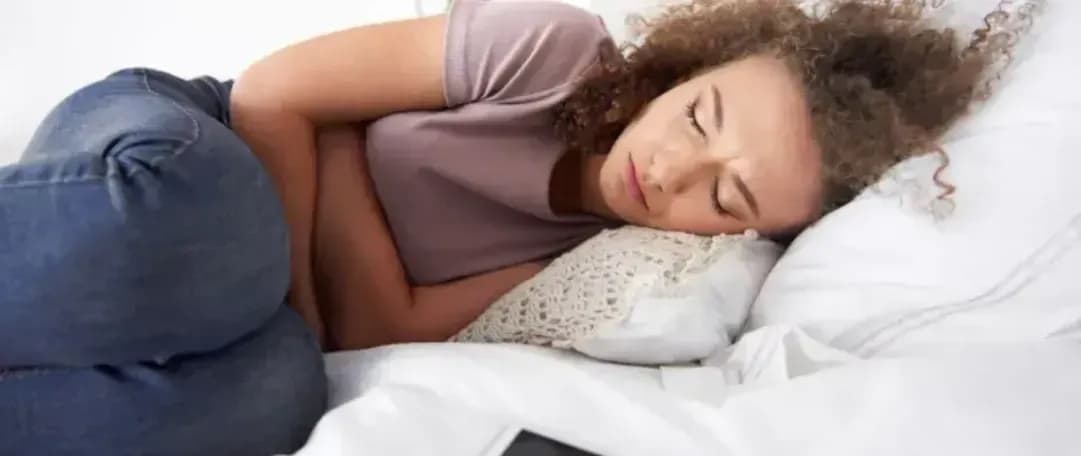
If there is one sentence that can leave us moms full of questions when our daughters start getting their periods, it is this simple one: “Mom, my stomach hurts.”
And then comes the question many of us quietly ask ourselves: Is it cramps? Is it a stomachache? Is her period coming?
When the first cycles begin, it is completely normal for your daughter not to know exactly how to explain what she is feeling.
She is getting to know a body that is changing quickly, and she may not yet have the words to describe pressure, a sharp pain, or that unfamiliar discomfort in her lower abdomen. And that is okay. Learning happens gradually, through information, conversation, and reassurance.
So instead of trying to immediately guess what is causing the pain, let's learn to observe the signs together.
Understanding where the pain is, when it appears, what it feels like, and which other symptoms come with it can help your daughter get to know her body and recognize when it is time to ask for help.
How can you tell if it is menstrual cramps or a stomachache?
Menstrual cramps are usually related to menstruation and generally occur in the lower abdomen. Stomach pain, however, can have many different causes and is not necessarily related to the menstrual cycle.
The tricky part is that, for a girl experiencing her first cycles, these sensations can feel very similar.
So, if your daughter comes to you saying that she is in pain, you do not have to immediately tell her, “It is cramps.” Instead, take the opportunity to talk. Ask when it started, where it hurts, and how she would describe the sensation.
These simple questions can help both of you understand what is happening.
A practical way to observe is to pay attention to a few things:
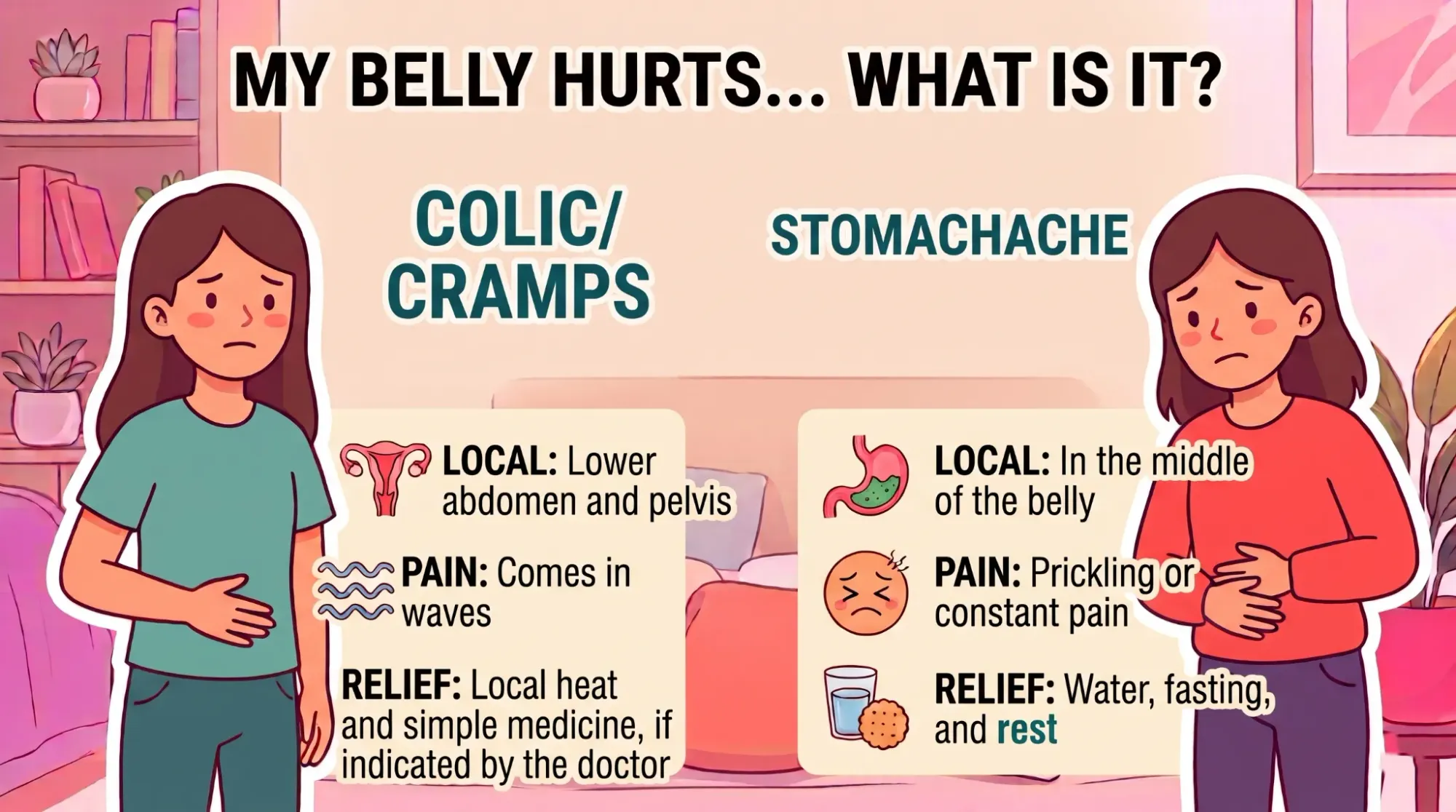
Remember that none of these questions are meant to diagnose anything at home. They are meant to teach your daughter to pay attention to her body. And that is an important skill, especially now that she is beginning to get her period.
Where is the pain located?
The location of the pain can provide some clues. Menstrual cramps usually occur in the lower abdomen and may also be felt in the lower back.
Some girls notice heaviness or pressure, while others describe a tightening sensation that comes and goes.
Stomach pain, on the other hand, can occur in different areas of the abdomen and be associated with other sensations. But there is no rule that says “pain here means cramps” and “pain there means an intestinal issue.” The body is not that simple.
So, when your daughter points to her stomach, sit beside her and talk. If she says, “It feels like it is squeezing,” for example, you already have useful information about what she is experiencing.
What does the pain feel like?
You can ask: “Does it feel like a sharp pain or a squeeze?”, “Does the pain stay there or come and go?” or even “If you had to explain this feeling to someone, how would you describe it?”
And do not worry if she does not know how to answer. She may need time to learn. What matters most is that she knows she can tell you what she is feeling without being judged or hearing that it is “just in her head.”
When does the pain appear?
The timing of the pain also matters. If it appears before or during menstruation and follows a similar pattern in other cycles, there may be a connection with the menstrual period.
But if the pain appears at different points in the cycle without a clear pattern, it is important not to automatically blame menstruation. After all, stomach pain can happen for many reasons.
A simple tip is to start observing and tracking. Over time, you and your daughter may notice that certain symptoms appear at specific points in her cycle.
And recognizing these patterns can bring a tremendous sense of security to a girl who is still discovering how her body works.
Why can cramps happen during the first period?
The first period is a big new experience. Along with menstrual bleeding, your daughter may notice sensations she has never experienced before. That is why it is not unusual for her to feel worried when she notices pain or discomfort in her stomach.
Cramps happen mainly because of uterine contractions during menstruation.
Substances called prostaglandins are involved in this process and are associated with uterine contractions and the sensation of pain.
You do not need to turn this into a complicated biology lesson. Simply help her understand that the uterus is also actively involved in the process.
What happens in the uterus during menstruation?
During the menstrual cycle, the uterus goes through several changes. When menstruation begins, the uterus sheds the lining that formed during the cycle. This is a natural part of how the body works.
To help with this process, the uterus contracts. You can explain it to your daughter in a very simple way: “Your uterus is working during your period, and every girl may feel this process differently.”
READ MORE | How the cycle really works: a conversation within your body
Does every girl have cramps during her first period?
No. And this is an important thing to share with your daughter.
Some girls have cramps during their first cycles. Others experience only mild discomfort, while some do not feel pain at all. The intensity can also change from one cycle to another.
Every body has its own rhythm. One of the best things we can give our girls during this stage is the opportunity to understand their own patterns instead of expecting them to feel exactly what someone else feels.
Can cramps come with other symptoms?
They can. Some girls may experience nausea, intestinal changes, headaches, or lower-back discomfort along with cramps.
And that helps explain why your daughter may simply say that she has a “stomachache.” After all, she is still learning how to distinguish between all these different sensations.
What helps relieve cramps during early adolescence?
Now that you know cramps can be part of the first cycles, let's talk about something every mom wants to know: what can we do to help when the pain appears?
First, offer reassurance. Then, you can discover together what makes her feel more comfortable.
Can heat help?
Local heat can be an option for providing comfort during cramps. A warm heating pad placed over the abdomen may help some girls relax and cope better with the discomfort.
You can also turn this into a moment of care. Make a drink she likes, let her rest for a while, and take the opportunity to talk if she wants to.
These small moments teach an important message: taking care of your body also means respecting when it needs a break.
Rest or movement: which is better?
It depends on your daughter. Some girls prefer to stay still when they have cramps. Others notice that walking or gentle movement helps them feel better.
There is no obligation to choose one or the other. If she feels comfortable moving, that is fine. If she wants to rest, that is fine too.
What about medication for cramps?
In some situations, medication may be used to manage menstrual pain, but it should not be chosen or given without professional guidance.
If your daughter has frequent cramps or if the pain is interfering with her routine, talk to the healthcare professional who follows her. They can evaluate the situation and recommend the most appropriate care.
READ MORE | Menstrual poop explained: a guide for girls getting their first period
How can you help your daughter understand her pain?
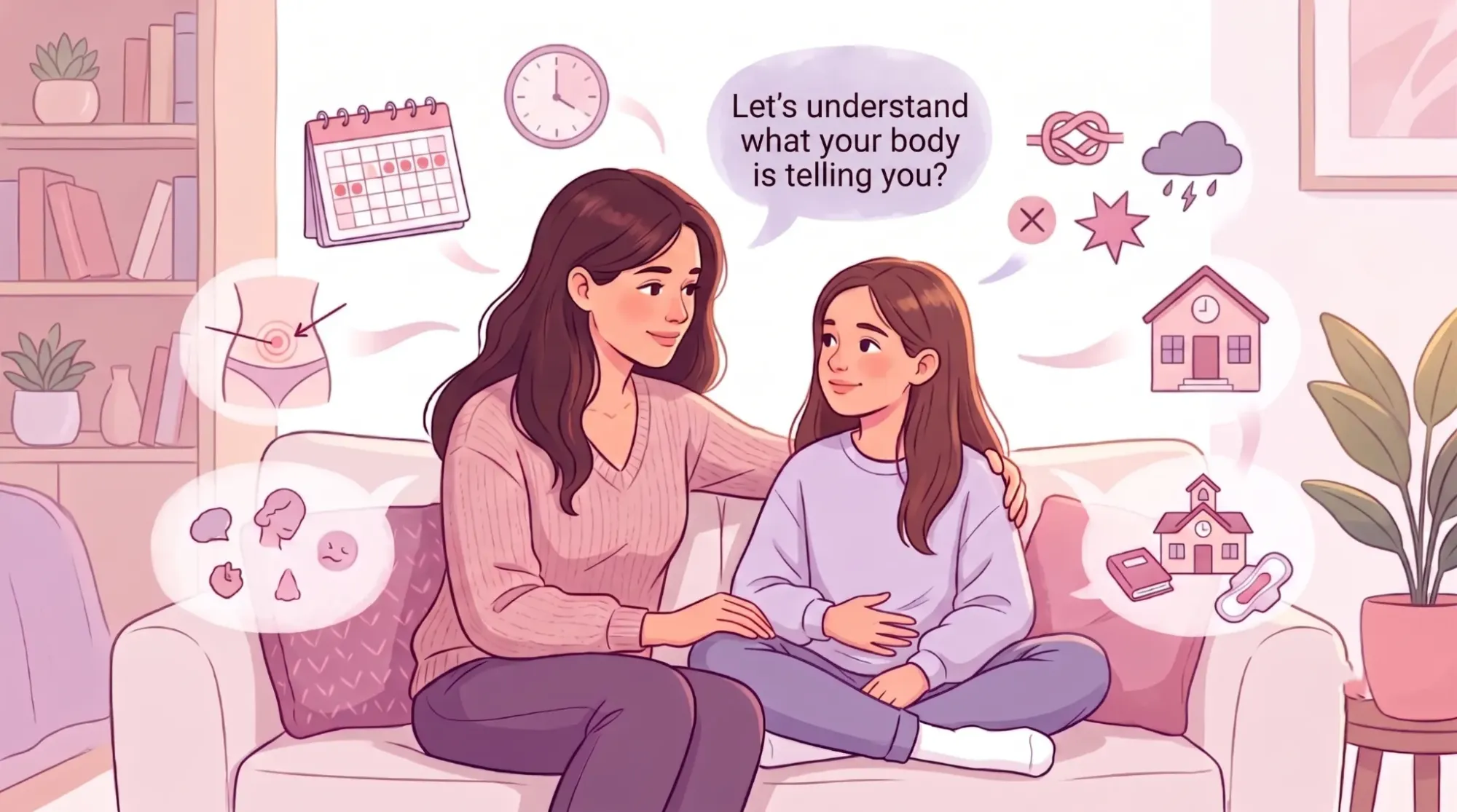
Maybe you are thinking, “But how can I teach my daughter to notice all of this if she does not even know how to explain what she feels yet?” Take a breath. You do not have to teach her everything at once.
Start with small conversations. When she gets her period, ask how she is feeling. When she complains about pain, help her describe it. When the cycle ends, talk about how it went.
Over time, she will begin asking herself these questions.
Tracking symptoms can help identify patterns
We do not always remember exactly how we felt a few weeks ago. That is why tracking the cycle and symptoms can be a simple way to help your daughter recognize patterns.
She can keep track of when her period started, how she was feeling, whether she had cramps, and which symptoms appeared. After a few cycles, you can look at the information together and notice what tends to happen.
This is where Soso can become part of your routine. The app is designed to help girls track their cycle, record symptoms and feelings, and build a calmer relationship with the changes happening in their bodies.
Instead of turning every symptom into a reason to worry, you have a space to observe and understand what is happening.
Talking about cramps is also menstrual education
When you talk to your daughter about cramps, you are teaching her much more than one way to relieve pain. You are showing her that her body deserves attention, respect, and care.
And perhaps that is one of the most beautiful parts of this stage. At first, you help her put names to things. Then she starts recognizing them on her own. Little by little, the girl who once said, “My stomach feels weird,” becomes able to explain exactly what she is feeling.
Cramps do not have to be a mystery for your daughter
If your daughter is experiencing her first cycles, it is completely understandable that she may not know how to tell the difference between menstrual cramps and a stomachache. After all, no one is born knowing how to interpret the signals their body sends. We learn through conversation, observation, and experience.
And remember: you do not need to have all the answers to be the mother your daughter needs during this stage. Sometimes the most important thing is simply being able to say, “I don't know, but we'll figure it out together.”
Is your daughter discovering her cycle? Make this stage a conversation, not a drama.
With Soso, your daughter can track her cycle, record what she is feeling, and start understanding the changes happening in her body.
Explore Soso and be by her side through this process, offering information, reassurance, and confidence so that menstruation becomes less of a mystery and simply another part of growing up.
Comments (0)

Veronica Tarsitano is a nursing student and a Brazilian living in Portugal. Married and a mother of three, including the girl who inspired the name "Sosô". She writes based on the real-life experience of closely following a daughter's first period, without filters.
Download the Soso app and put this into practice
Download the appRelated Posts
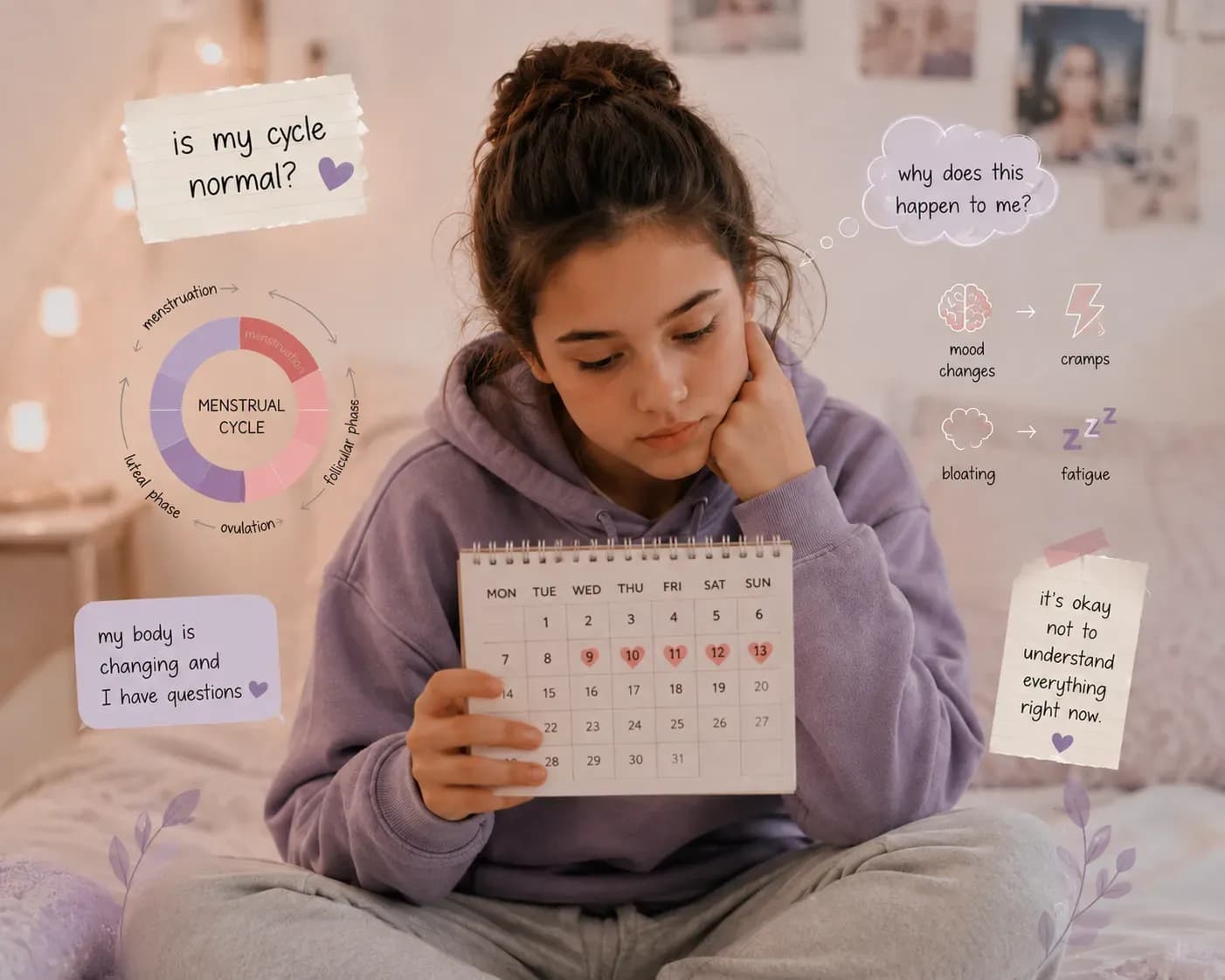
How to tell the difference between spotting and a period
Spotting is light and irregular bleeding, while menstruation usually lasts longer and follows the cycle’s usual pattern.
%25201200x675%2520pixels%2520(2)-1.webp&w=3840&q=75)
I woke up to a stained sheet: what to do in the middle of the night without panicking
Waking up and noticing a blood stain on your sheet can be scary, especially when it happens for the first time. But the truth is that this kind of situation is much more common than you might think.
How your cycle works and the group chat inside your body
Understanding your menstrual cycle doesn't have to be complicated. Think of your body as an exclusive 'chat group' where the brain, ovaries, and uterus use hormones instead of text messages to coordinate your monthly rhythm. From the first day of your period to the subtle clues your body leaves behind, discover how this unique communication system works and why your cycle is as individual as you are.