
How your cycle works and the group chat inside your body
Understanding your menstrual cycle doesn't have to be complicated. Think of your body as an exclusive 'chat group' where the brain, ovaries, and uterus use hormones instead of text messages to coordinate your monthly rhythm. From the first day of your period to the subtle clues your body leaves behind, discover how this unique communication system works and why your cycle is as individual as you are.
Your body has a chat group (like the one with your friends) that never stops.
In this group are the brain, the ovaries, and the uterus. And instead of text messages, they use hormones to talk.
Sometimes, one hormone says, "time to start a new cycle." Another warns, "the egg is getting ready." And others help the uterus prepare, maintain, or shed its inner lining.
It seems complicated, but it gets much easier when we know each participant.
Who participates in this conversation?
The brain
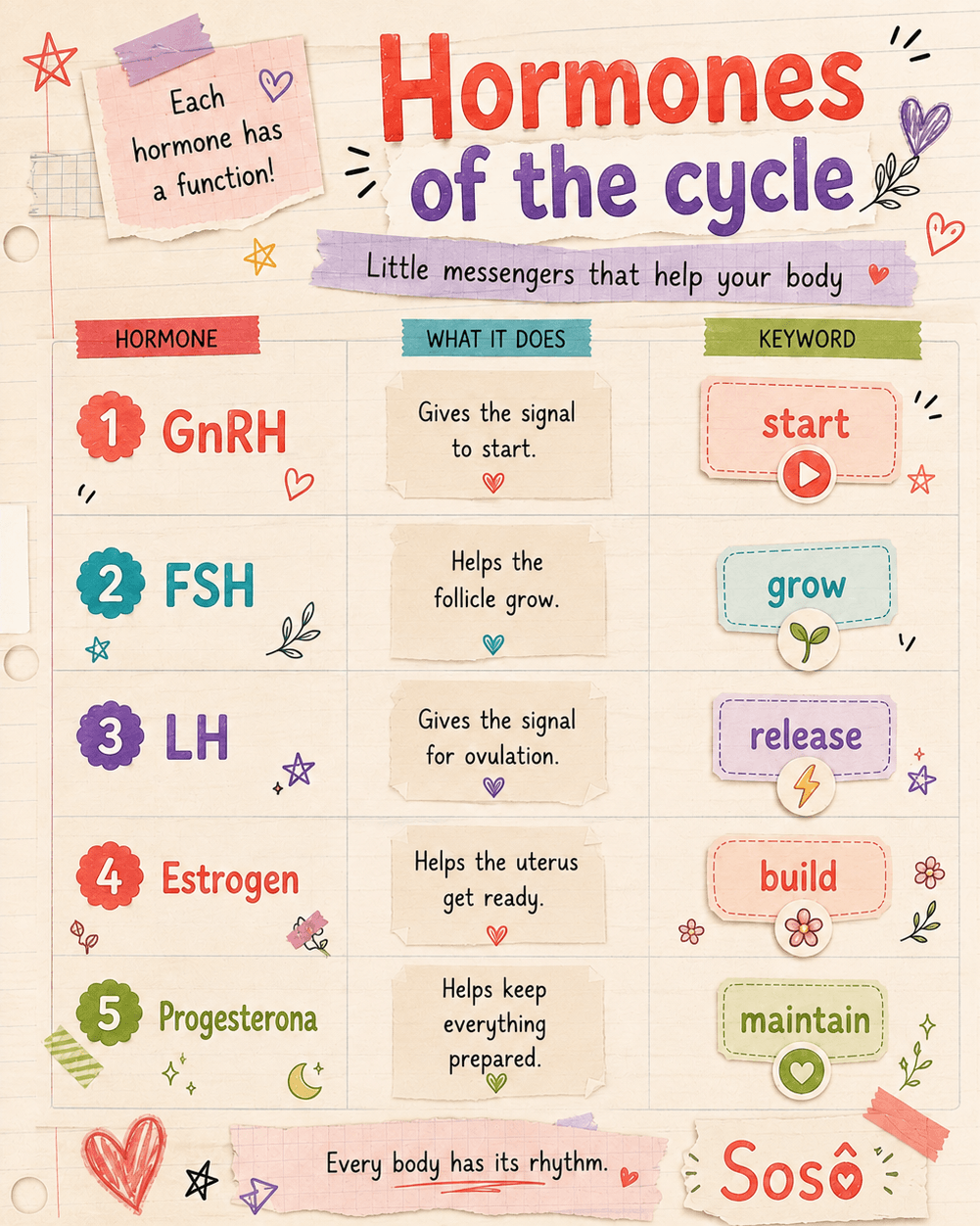
Everything starts in a region of the brain called the hypothalamus. It sends a hormone called GnRH, which works as the first message of the conversation.
GnRH signals the pituitary gland, a very small gland located at the base of the brain, that it's time to send two new messages: FSH (which assists in follicle growth) and LH (which finishes preparing the follicle and promotes ovulation).
The ovaries
The ovaries receive FSH and LH.
FSH helps small follicles grow. Each follicle is like a small sac that holds an egg.
As one of these follicles grows, the ovary produces more and more estrogen. Near ovulation, LH rapidly increases and helps the ovary release an egg.
The uterus
Inside the uterus, there is a soft layer called the endometrium.
During the cycle, this layer grows and becomes more prepared. When it is not used, the body eliminates it. This is what forms menstruation.
Menstrual blood is not "dirty" blood. It is a mixture of blood, endometrial tissue, and natural body secretions.
The four phases of the cycle
1. Menstruation: the cycle begins
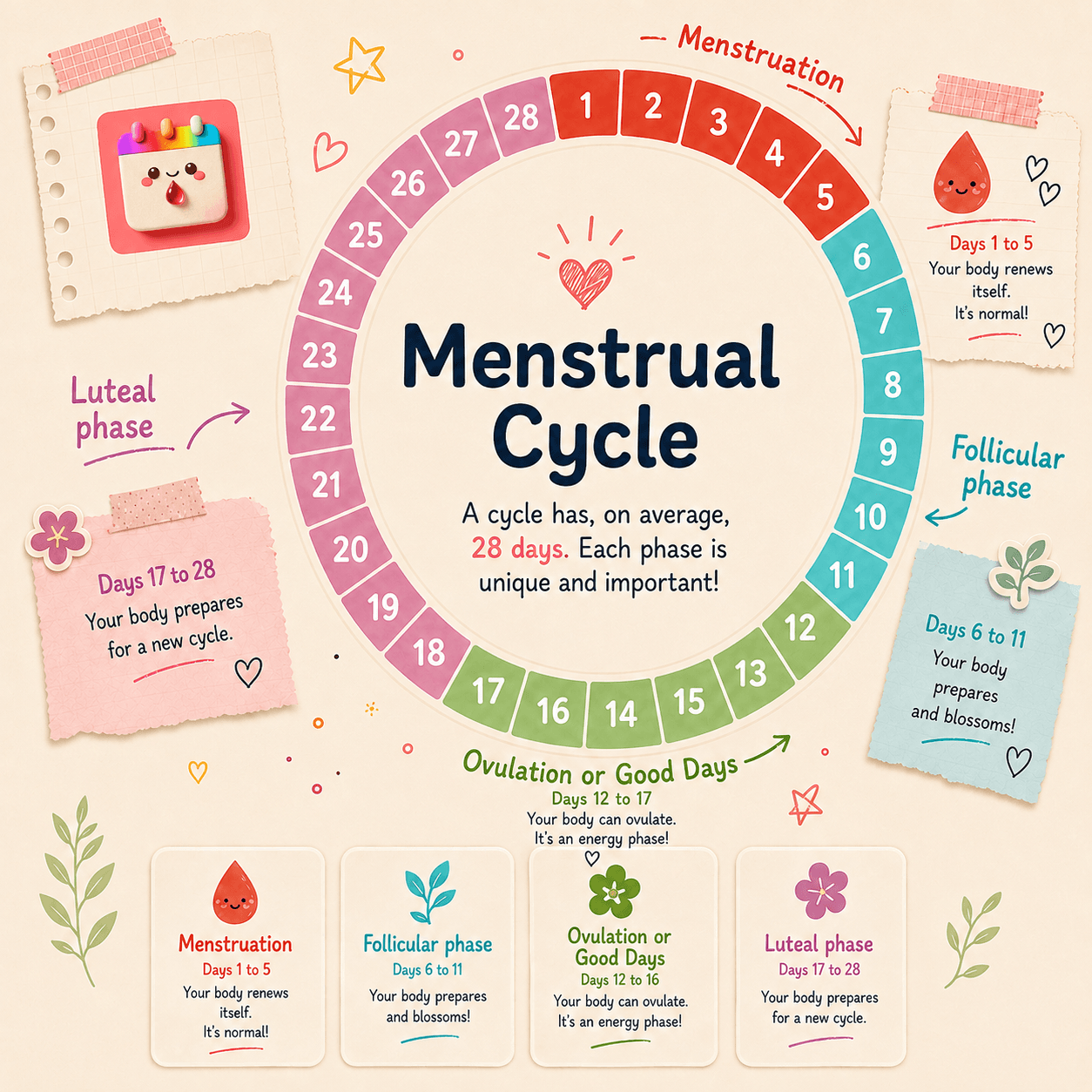
The first day of bleeding is considered Day 1 of the cycle.
At this time, estrogen and progesterone levels are low. Without these hormones to maintain the endometrium, this layer begins to shed, and bleeding occurs.
This is menstruation.
During these days, you may feel cramps, tiredness, back pain, bloating, or mood changes. But every body reacts differently.
Some girls feel many things, and others barely notice changes.
2. Follicular phase: rebuilding everything
While menstruation is happening, the brain already begins to organize the next cycle.
FSH stimulates the growth of follicles in the ovaries. Usually, one of them develops more than the others.
This follicle produces estrogen.
As estrogen increases, the endometrium begins to grow again. It's as if the uterus is rebuilding its inner layer after menstruation.
Some girls notice more energy or changes in vaginal discharge during this phase. Others don't notice anything different, and that is also normal.
3. Ovulation: the egg is released
When the estrogen level is sufficiently high, the brain receives a new signal. This causes a rapid increase in LH, known as the LH peak.
This peak helps the follicle release an egg. This moment is called ovulation.
But here is important information: in the first few years after the first menstruation, not all cycles have ovulation.
4. Luteal phase: keeping the endometrium prepared
After ovulation, the follicle that released the egg transforms into a structure called the corpus luteum. The corpus luteum primarily produces progesterone.
Progesterone helps keep the endometrium more stable and prepared.
When pregnancy does not occur, the corpus luteum decreases its activity. Progesterone and estrogen levels drop, the endometrium loses its support, and a new menstruation begins.
And that's it: the chat group starts another cycle.
So, will the cycle always be 28 days?
No.
Twenty-eight days is just an example used to facilitate explanations. It is not a goal your body must meet.
In adolescents, especially in the first few years after the first menstruation, cycles can vary widely. One cycle may be shorter, the next longer, and gradually, they may become more predictable.
This happens because the communication between the brain, ovaries, and uterus is still maturing.
Therefore, don't compare your cycle with that of a friend, sister, or person on the internet. Every body has its own rhythm.
Your cycle leaves clues
Observing your cycle is not only for knowing when your next period might arrive.
It also helps you notice:
• how long your cycles usually last;
• what your flow is like;
• when cramps appear;
• how your energy and sleep are;
• if there are changes in your skin, appetite, or mood;
• which signs repeat and which were different that month.
The more you know these clues, the easier it is to understand what is normal for your own body. Your cycle doesn't need to be perfect, punctual, or the same as someone else's.
It just needs to be known by you.

Medically reviewed
This article was medically reviewed by Fernanda Nunes Faggion.
Comments (0)
Fernanda Nunes Faggion is a physician who graduated from Kursk State Medical University (KSMU) in Russia in 2024, and is currently in the process of having her medical degree validated in Brazil and Portugal. Her academic path includes a Master's degree in Public Health and internship experience in vascular surgery and transplantology, which gave her a broad and solid grounding in medical practice. Driven by a deep admiration for women's health, she found her true purpose in caring for women. She believes that care goes beyond treating illness: it means understanding each patient in her individuality, respecting her story, her cycles, and her needs.
Download the Soso app and put this into practice
Download the appRelated Posts
%25201200x675%2520pixels-1.webp&w=3840&q=75)
First period during a vacation trip: how to pack the perfect bag
Going on vacation with your daughter as she enters puberty? Besides clothes and travel documents, a few simple items can make all the difference if her first period happens during the trip.
How to tell the difference between spotting and a period
Spotting is light and irregular bleeding, while menstruation usually lasts longer and follows the cycle’s usual pattern.
%25201200x675%2520pixels%2520(54)-2.webp&w=3840&q=75)
Is it normal for your period not to come in the second month?
If your daughter got her first period and then nothing happened the following month, I can imagine the question that may have crossed your mind: “Could something be wrong?”