Headaches in pre-adolescence: when hormones might be to blame
Hormonal changes during puberty and throughout the menstrual cycle can contribute to headaches in some girls, but there are other possible causes too.
You got your period and, all of a sudden, noticed that your head decided to join in on the whole thing too?
Maybe you’ve had a headache before your period, during those days, or even afterward, and found yourself wondering, “Could one thing have something to do with the other?” If that’s happened to you, know that it’s a pretty understandable question at this stage.
Your period can come with all kinds of symptoms, and headaches are one of them. But that doesn’t mean every headache you get around your period is caused by hormones.
During pre-adolescence, your body is going through lots of changes at once, so it’s worth looking at the whole picture before jumping to a conclusion.
What are the most common reasons for headaches in pre-adolescence?
There are lots of reasons your head might hurt. You might be tired, have gone too long without eating, not have had enough water, or even have spent too many hours looking at a screen.
Stress, changes in your routine, and some illnesses can also cause headaches. So you can’t automatically blame every headache on your period.
At the same time, if you’ve recently started getting your period, you might notice changes that weren’t part of your routine before.
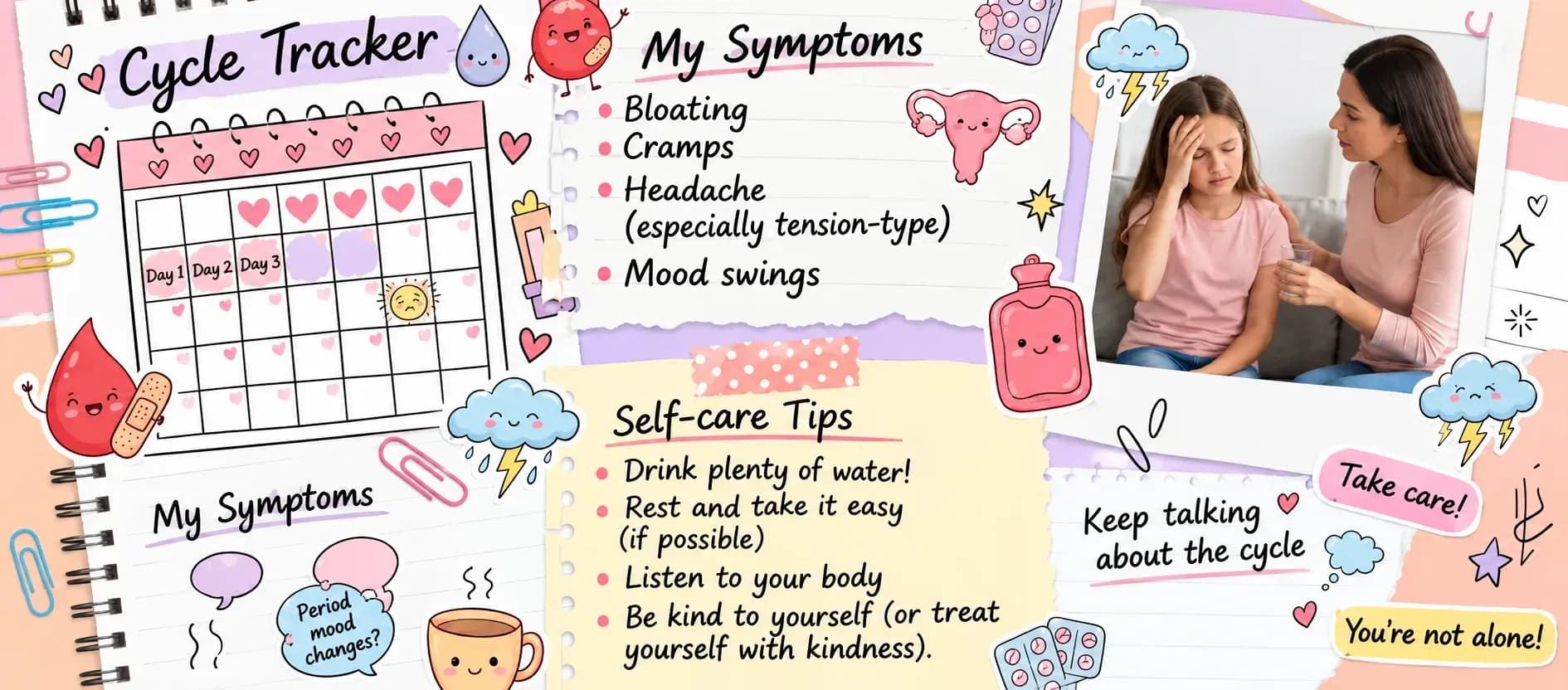
Some girls get headaches before or during their period, and some may experience migraines related to their cycle.
The ACOG, a medical organization specializing in women’s health, also recognizes headaches as a possible symptom that can happen during this stage.
And there’s an important difference here: a headache isn’t necessarily a migraine.
A migraine can involve more intense pain and may also come with nausea or increased sensitivity to light and sound. Only a healthcare professional can assess your symptoms and tell you what’s going on.
So, what do hormones have to do with it?
Now we’re getting to the part that might sound complicated, but it doesn’t have to be. During puberty, your body starts to produce and regulate hormones differently.
These changes are part of all kinds of transformations you may have already noticed, like breast development, body hair growth, changes in your skin, and, of course, getting your period.
Estrogen is one of the hormones involved in your menstrual cycle, and its levels change throughout it.
Researchers are studying whether the drop in estrogen around your period may trigger migraines in some women. But science doesn’t have all the answers yet: these studies were done with adults, and migraines don’t depend on estrogen alone.
That’s because hormones can play a role in the way your brain perceives and processes pain.
But here’s the thing: a hormonal change isn’t necessarily the explanation for every headache that happens around your period.
READ MORE | Find out if your first period is coming!
How can you tell if your headache might be related to your cycle?
Imagine your head starts hurting today. You look at the calendar and realize your period is coming. So, does that mean you can say it was the hormones? Not yet.
One coincidence between a headache and your period isn’t enough to know whether there’s actually a connection.
What can help is looking for a pattern. Instead of trying to figure everything out at once, you can pay attention to a few things.
What’s worth paying attention to:
- Start of the pain: did it begin before, during, or after your period?
- Duration: did it go away quickly or last several hours?
- Other symptoms: did it cause nausea or a wish to stay somewhere darker?
- Sensitivity: did light or noise bother you more while your head hurt?
- Sensitivities: did bright lights or loud noises feel bothersome while your head hurt?
- Daily routine: did you sleep well, eat normally, and drink enough water?
- Activities: did the pain get in the way of studying, school, or outings?
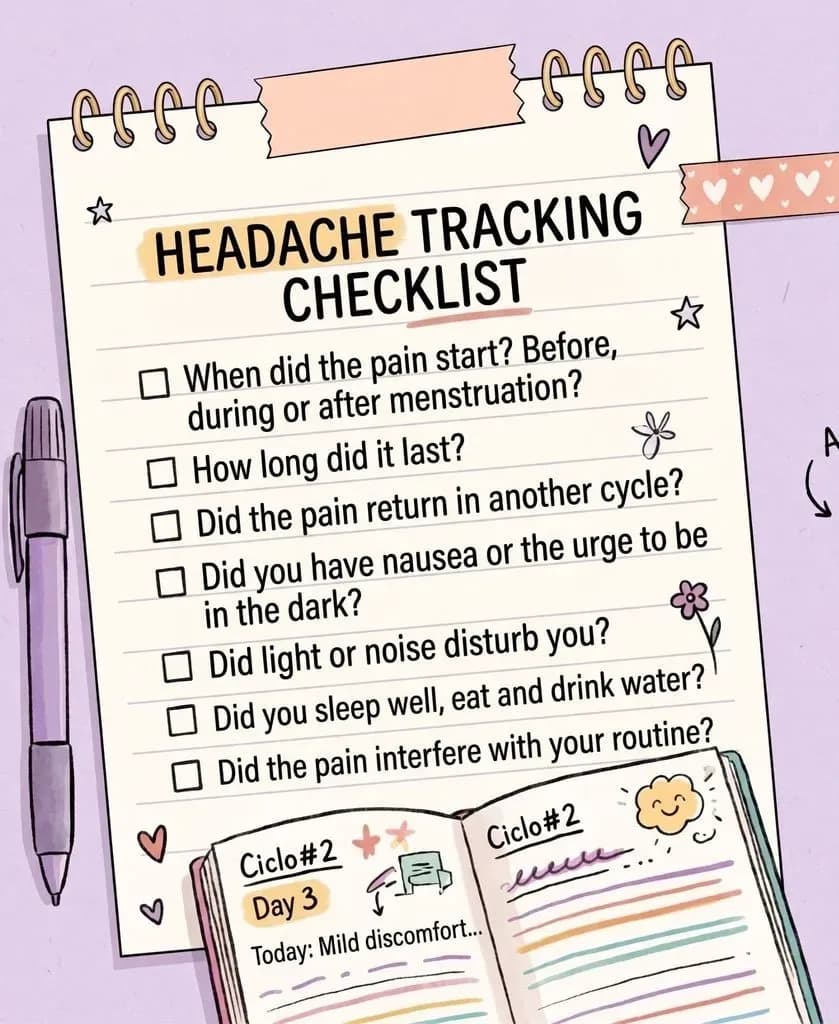
This information can help you and a trusted adult notice whether there’s a pattern.
If the headache keeps showing up at a certain point in your menstrual cycle, for example, it’s worth telling a healthcare professional about it.
And there’s one important thing to remember: one isolated episode doesn’t prove that your headache is hormonal. Paying attention to your body is simply a way to gather information before drawing conclusions.
What can you do when your head starts to hurt?
First, tell a trusted adult that your head hurts. It could be your mom, dad, another family member, or another adult who’s responsible for you.
It’s also worth taking a moment to pay attention to your body’s basic needs.
Have you had enough water today? Have you eaten anything? Did you get enough sleep? Have you spent hours studying or looking at a screen?
Sometimes, a simple change in your routine can make a difference for certain types of headaches.
When your head hurts, try to stay somewhere comfortable and notice whether bright lights or loud noises make things worse. If you can, get some rest.
Afterward, you can write down when the headache started and where you were in your cycle at the time. Keeping track can be useful if the headache happens again.
When to get medical help?
Most of the time, a headache goes away on its own. But some signs need medical attention right away. If you have any of them, tell an adult immediately. Don’t wait for the pain to pass.
- Headache with fever and neck pain or stiffness
- Pain that wakes you up from sleep
- Pain after hitting your head
- Vomiting that won’t stop or is forceful
- Changes in vision or double vision
- Confusion, unusual sleepiness, trouble waking up, tingling, or weakness
- Sudden, very severe pain that happens for the first time
Moms and caregivers: if your daughter has any of these signs, go to an urgent care or emergency service.
When is it time to tell an adult?
You can tell an adult anytime you’re worried about something you’re feeling. It’s worth talking to one the same day, and booking a visit with a pediatrician, if the pain:
- Is strong or happens often
- Keeps getting worse over time
- Makes you miss school or stop playing, studying, or doing things you enjoy
- Is new and feels very different from what you usually feel
- Comes with other symptoms that worry you or your caregiver
A healthcare professional can assess what’s going on and tell whether there’s a connection with your cycle or another explanation.
It’s especially important to talk to a trusted adult if the pain is very severe, happens often, keeps getting worse, or starts to get in the way of your routine.
If you’re missing school, skipping activities, having trouble studying, or stopping things you normally enjoy because of the pain, that deserves attention too.
It’s also important to speak up if it’s a new headache that feels very different from what you usually experience, or if it comes with other symptoms that worry you or your caregiver.
In these situations, a healthcare professional can assess what’s going on and figure out whether there’s a connection with your cycle or another possible explanation.
Most importantly, don’t try to diagnose yourself. Your body is changing, and you’re still learning how to recognize its signals. Having questions is part of that process.
Important notice: this content is for information and education only. It does not replace advice, diagnosis, or treatment from a healthcare professional. If you have questions about your health, talk to a trusted adult and see a doctor.
READ MORE | First period kit: what to keep at home and in your backpack
Your body, your pace
Getting your period brings lots of new things at once, and headaches can be one of them. Instead of trying to guess the answer right away, you can pay attention, keep track, and talk to a trusted adult. And remember: don’t try to diagnose yourself.
Want to start understanding your cycle better? Download Soso and keep track of how you’re feeling so you can follow your changes over time.
You don’t have to remember everything or do it perfectly. What matters is starting to get to know your body at your own pace.
Comments (0)

Veronica Tarsitano is a nursing student and a Brazilian living in Portugal. Married and a mother of three, including the girl who inspired the name "Sosô". She writes based on the real-life experience of closely following a daughter's first period, without filters.
Download the Soso app and put this into practice
Download the appRelated Posts
How to tell the difference between spotting and a period
Spotting is light and irregular bleeding, while menstruation usually lasts longer and follows the cycle’s usual pattern.
Period cramps or stomachache? How to tell the difference and help during early adolescence
Your daughter has a stomachache and you are not sure whether it is menstrual cramps? Learn how to recognize the signs and help your daughter understand her body without fear or drama.

I woke up to a stained sheet: what to do in the middle of the night without panicking
Waking up and noticing a blood stain on your sheet can be scary, especially when it happens for the first time. But the truth is that this kind of situation is much more common than you might think.