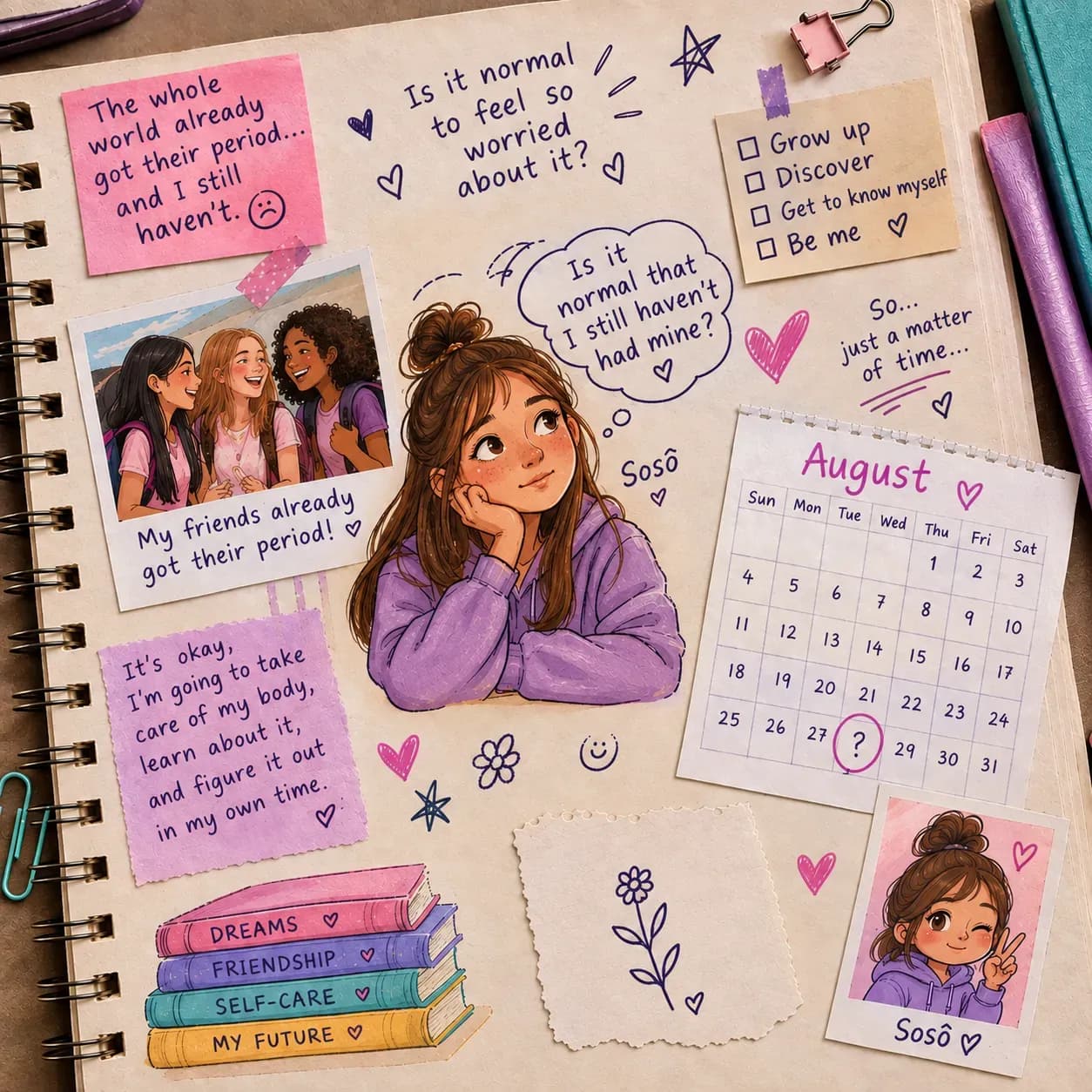
My friends have already gotten their periods and I haven't. Is something wrong with me?
Your friends have already gotten their periods and you're still waiting? Take a breath. I'm Soso's Mom, and I'm here to tell you what might be happening with your body.
You find out that another friend got her period. Then another tells you she's been getting hers for a few months.
And before you know it, a conversation that seemed totally normal leaves you with one little question in your head: “What about me? When is it going to happen to me?”
If you've had that thought, I want to start with something important: getting your period at a different time from your friends doesn't mean there's something wrong with your body.
I know this not just because I'm a mom, but because I watched Soso go through this up close. In our case, though, things happened differently from what you're experiencing.
Soso got her first period at 10 and was the first of all her friends. And you know what I learned? Being the first can feel a little lonely too.
She had questions, new feelings, and things she wanted to talk about, but her friends weren't going through the same thing yet.
That's when I realized that whether you're the first or the last in your group, feeling different can be hard.
So, let's talk about it.
If my friends have already gotten their periods, why haven't I?
Because your body doesn't schedule your first period around your friends' periods. I know. It'd be much easier if it worked that way.
You could look at your best friend, see that she got her period, and think, “So mine must be coming soon.”
But it doesn't really work like that. Puberty happens at different times for different girls.
Your first period usually happens a few years after breast development begins, but there's a lot of variation in when it happens.
That's why two girls the same age can be at completely different stages. One may have already gotten her period while another is just starting to notice changes from puberty. Both can still be developing normally.
What if I'm feeling left behind?
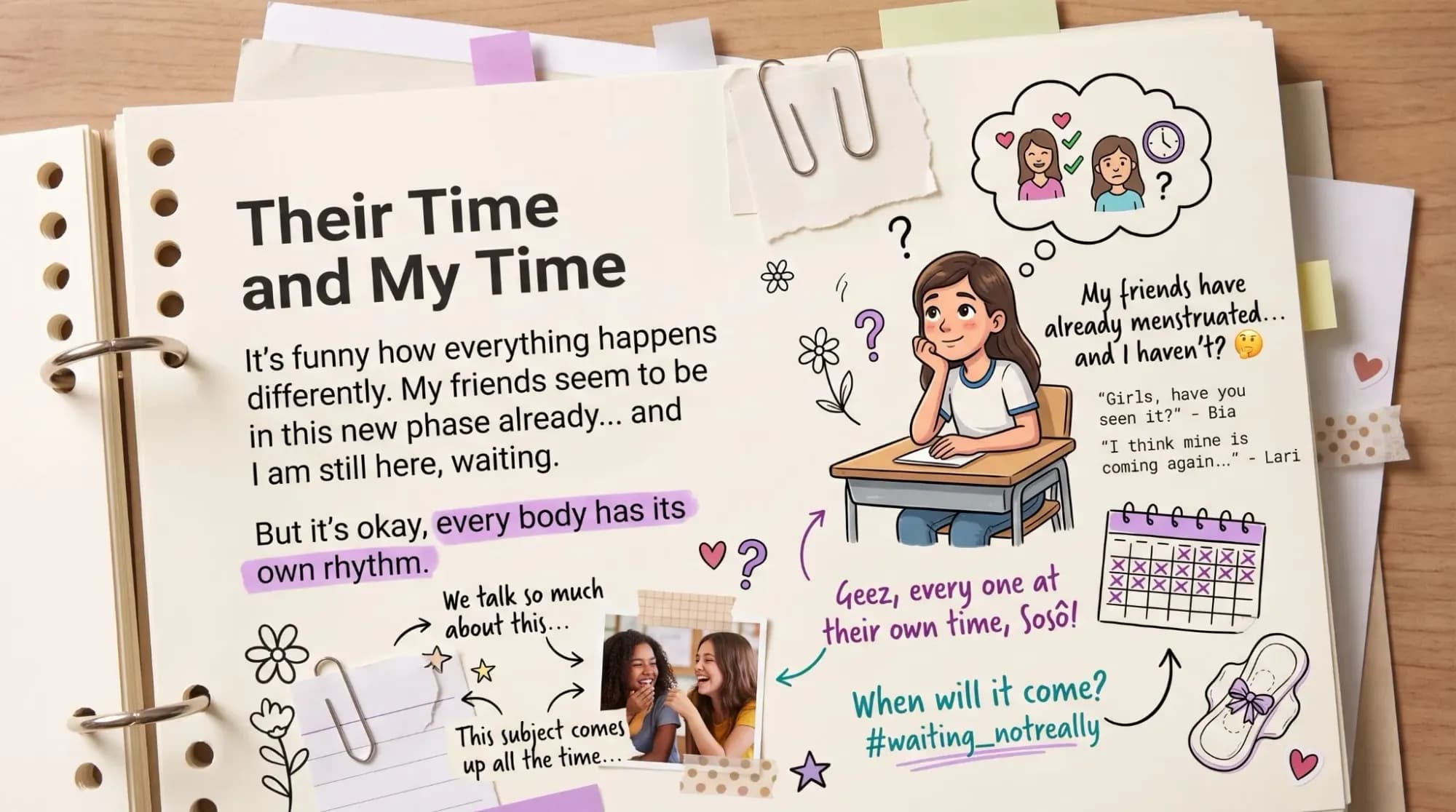
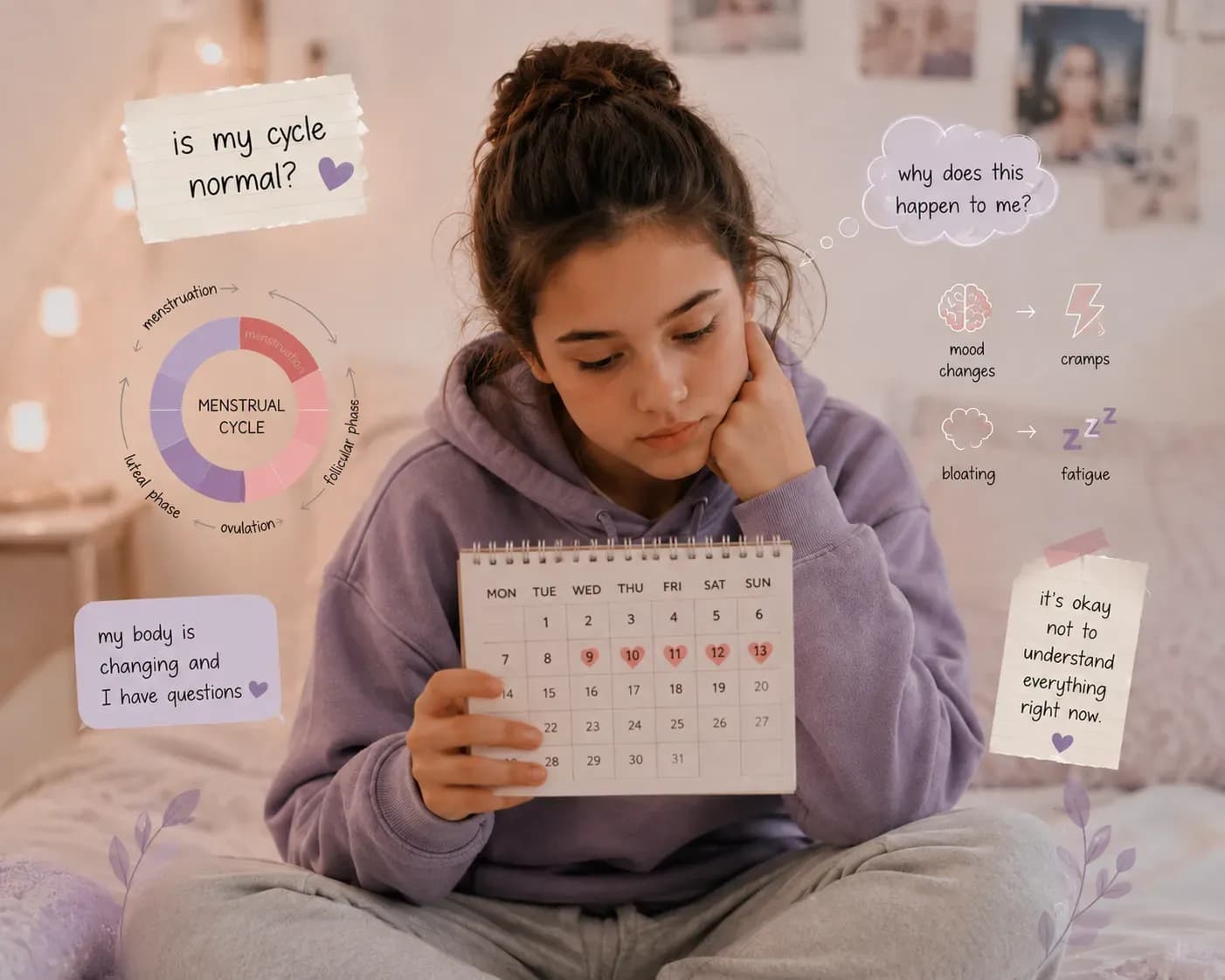
This part deserves attention because sometimes the hardest thing isn't the period itself. It's feeling different.
When your friends start talking about pads, cramps, flow, or what their first period was like, you might not know what to say.
Maybe you even want to join the conversation, but worry that no one will understand because it hasn't happened to you yet.
And it's okay if that gets to you. You're not being dramatic for feeling this way.
When Soso got her period, I saw this other side of it. She was the first in her group and didn't have a friend going through the same thing to share the experience with.
So, if you're experiencing the opposite, I can understand why you might get that “I'm the only one” feeling.
But there's an important difference: being at a different stage doesn't mean you're behind.
You don't have to pretend you've gotten your period just to fit into a conversation. And you don't have to feel embarrassed because it hasn't happened yet.
If someone asks and you want to answer, you can simply say that you haven't gotten it yet.
And if you don't want to talk about it, that's okay too.
How can I tell if my first period is coming?
This is one of the questions I wish I could answer with an exact date.
“You'll get your period on the 17th.” Done. Problem solved. I'd love to be able to put it on your calendar.
But your body doesn't send you an invitation with a date and time for your first period.
What you can do is look for some changes that often happen during puberty.
Breast development is usually one of the first changes. You may also notice body hair growing in your pubic area and under your arms, faster growth, changes in your skin and body odor, and clear or whitish vaginal discharge.
These signs can help you understand that your body is going through puberty, but they can't tell you exactly when your first period will happen.
Can I know the exact day I'll get my first period?
No. And I know that's probably not the answer you wanted.
There are ways to notice the signs of puberty and better understand what stage your body is in. But that's different from being able to put a date on the calendar.
Even the Soso app is careful about this. The goal isn't to create a countdown that makes you even more anxious. It's to help you understand what's happening in your body and recognize the changes when they happen.
And when your period does come, you'll know what to do.
What can I do while I'm waiting?
While you're waiting for your first period, there's something much more useful than trying to guess the exact day: you can prepare without turning it into something to worry about.
For example, you can:
- learn how periods and the menstrual cycle work;
- find out how to use a pad;
- keep a pad in your backpack if that makes you feel more prepared;
- talk to your mom, dad, or another trusted adult if you have questions;
- notice changes in your body without comparing every detail with your friends;
- use Soso to learn about puberty and your first period in a simple, no-drama way.
And if a friend tells you she got her period, you can be happy for her without turning it into pressure on yourself.
Her time came. Yours will come when your body is ready.
One thing I want you to know
If your friends have already gotten their periods and you haven't, you might look at them and think you're falling behind.
But I want you to look at Soso's story from another angle.
She was the first of her friends to get her period. And even though she was the first, she sometimes felt lonely too.
That taught me that there's no perfect place to be in this story. Being first can feel strange. Being last can too.
What matters most is having information so you understand what's happening and having someone to talk to when you have a question you don't even know how to ask.
So, when you think “my friends have already gotten their periods and I haven't,” try changing the question.
Instead of thinking, “Why am I behind?” ask yourself: “Could my body simply be going through this stage at its own pace?”
And if you're still wondering, you can ask. Really.
That's exactly why Soso was created. So you can find answers about periods, puberty, and your first period without shame, pressure, or drama.
Explore Soso and find simple answers about your first period, puberty, and the menstrual cycle.
Important note: This content is for educational purposes and doesn't replace medical advice. If you're concerned about your development or have symptoms that worry you, talk to your mom, dad, another trusted adult, or a healthcare professional.
Comments (0)

Veronica Tarsitano is a nursing student and a Brazilian living in Portugal. Married and a mother of three, including the girl who inspired the name "Sosô". She writes based on the real-life experience of closely following a daughter's first period, without filters.
Download the Soso app and put this into practice
Download the appRelated Posts
How to tell the difference between spotting and a period
Spotting is light and irregular bleeding, while menstruation usually lasts longer and follows the cycle’s usual pattern.
Grossed Out by Period Blood? A Girl's Guide to Feeling Okay
Feeling disgusted by your own period blood is more common than anyone admits. Here is why your brain reacts that way and how to get comfortable, step by step.
Big Feelings Before Your Period Starts: A Girl's Guide
Suddenly feeling like crying, or your heart racing, even before your period has started? Here is why puberty stirs up big emotions and gentle ways to ride the waves.