Can you use tampons for your first period? Myths and facts
Tampons can be an option from your very first period. Learn how they work, whether they can hurt, and what you need to know to use them safely.
You just got your period and, when you started looking at your options, you came across a product that goes inside your body. Maybe one question popped into your head right away: “Can I use this already, on my first period?”
It’s a totally understandable question, especially when everything about your cycle is still new.
And the answer is yes. You can use tampons from your very first period, and there isn’t a specific minimum age for starting.
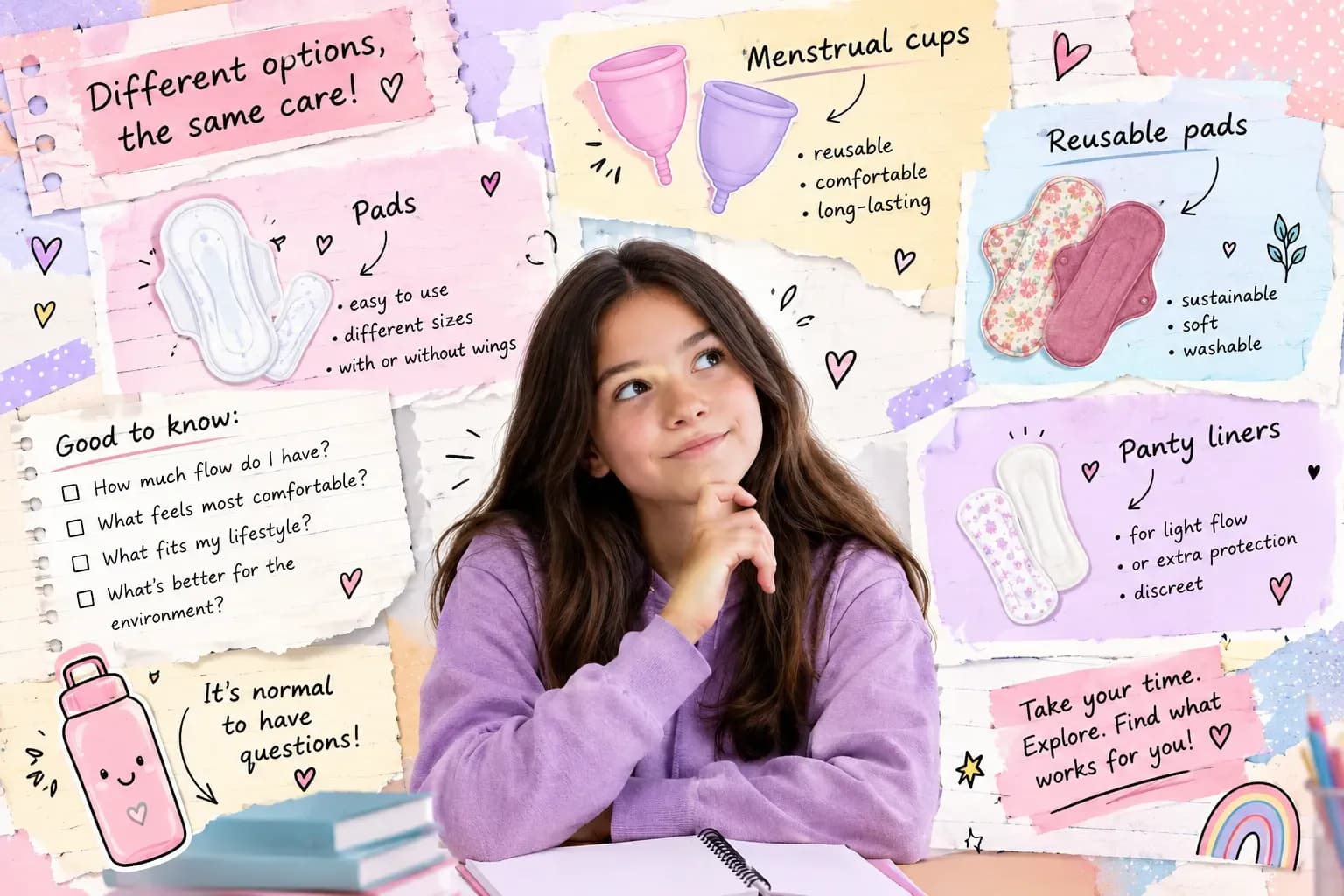
They’re one of the options for managing menstrual flow, just like pads and period underwear. The choice depends on what works for you and what makes you feel most comfortable throughout your day.
But if you’re thinking about trying a tampon for the first time, it’s normal to have some questions. Can it hurt? And what about the hymen?
Let’s go through these questions before you decide whether you want to use one.
Can tampons hurt?
When you’ve never used a tampon before, it’s easy to imagine that it might hurt because it goes inside the vagina. Maybe you’re even wondering if you’ll feel it or if it’ll hurt when you put it in.
But when it’s inserted correctly, a tampon should feel comfortable, and you shouldn’t feel it while you’re wearing it.
The American College of Obstetricians and Gynecologists (ACOG) explains that tampons come in different absorbencies.
That’s why it’s important to choose an option that matches your flow and follow the instructions on the package.
What if I feel pain?
Feeling something different can happen when you try a new product. After all, your body is getting used to something new, and you’re also learning how it works.
Pain, however, shouldn’t be part of using a tampon. If the tampon feels uncomfortable after you put it in or you feel pain while inserting it, take it out and don’t keep trying at that moment.
Some girls may have more difficulty because of their own anatomy, and talking to a healthcare professional can help you understand what’s going on if it keeps happening.
Can a tampon hurt the hymen?
This is a question that might come up when you’re thinking about using a tampon for the first time.
You may have heard that the hymen is some kind of “barrier” that protects the vaginal opening or that a tampon could break it. But that’s not quite how it works.
The hymen is a thin piece of tissue around the vaginal opening, and it already has an opening. Its shape can vary from one girl to another, and it can also stretch or change throughout your life.
So using a tampon doesn’t necessarily mean that your hymen will be torn or hurt.
READ MORE | Is This Normal? A Guide for Girls Through Their First Year of Periods
Can a tampon get stuck inside your body?
When you look at a tampon for the first time, it can be hard to imagine exactly where it goes. And it’s pretty easy to wonder: “What if it goes in and I can’t get it out?”
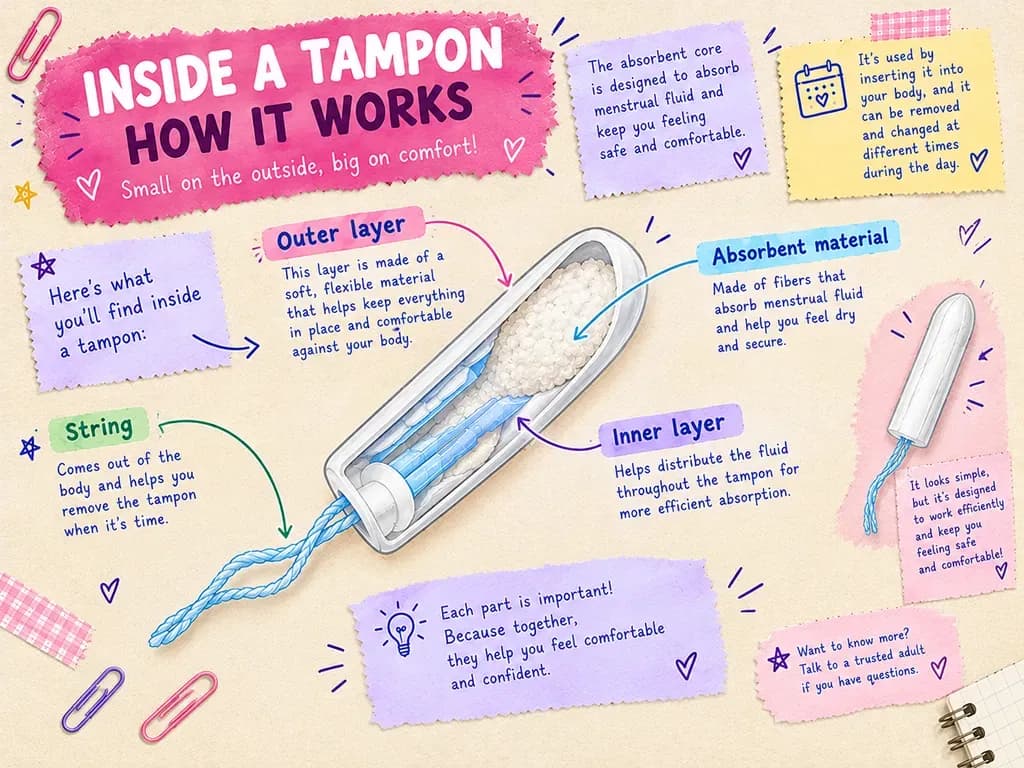
You can relax: it won’t get lost inside your body. The tampon stays inside the vagina, and at the end of it there’s the cervix, which keeps it from passing into other parts of your body. The string that stays outside is there to help you remove it.
If you ever have trouble taking the tampon out, you don’t need to panic or try to force it out on your own. Don’t use objects to pull it out, and don’t force the removal.
Ask a trusted adult for help or see a healthcare professional so it can be removed safely. And remember to follow the time limits on the package.
How do you choose a tampon when you’re just starting?
Have you noticed that tampons come in different sizes and absorbencies? That’s not by accident.
Your menstrual flow changes throughout your period: sometimes it’s heavier, and other times there’s only a little bit of blood. That’s why the tampon that works well one day might not be the best choice on another day.
If you’re thinking about trying one for the first time, you don’t need to choose the biggest one just because it seems like it’ll give you more protection.
Actually, the recommendation is to use the lowest absorbency that’s enough for your flow.
That means choosing an option that can absorb the amount of blood you have at that moment without using a higher absorbency than you actually need.
Imagine that your period is very light today, with only a small amount of blood. In that case, a lower-absorbency option may be enough. If your flow is heavier, you may need a higher absorbency.
The package usually tells you what level of flow each option is designed for, so it’s a good idea to check that information before choosing.
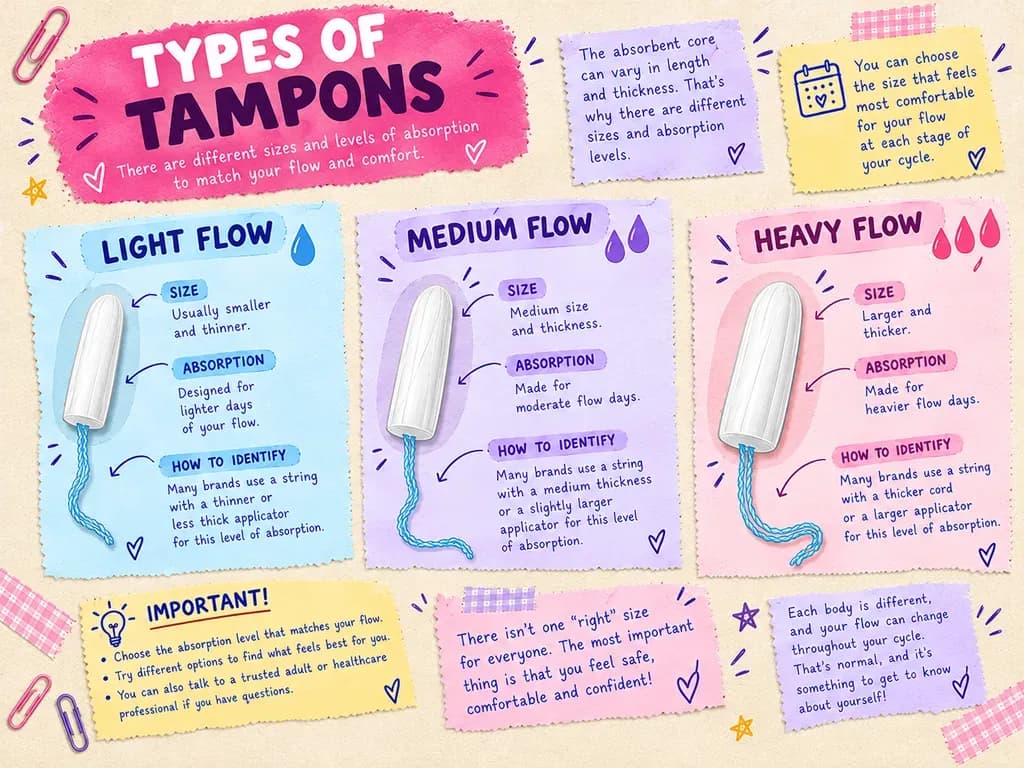
It’s also worth remembering that size and absorbency aren’t exactly the same thing. A tampon can be longer or have a different shape without necessarily having a higher absorbency.
So when you’re choosing one, pay special attention to the absorbency information on the package.
Little by little, you’ll figure out what works best for each day of your period. And when you’re starting out, there’s no need to make it complicated: pay attention to your flow, check the information on the package, and choose the lowest absorbency that’s enough for it.
How do you use tampons safely?
After choosing a tampon, there’s another important part: knowing how to use it safely.
Some rules might seem a little annoying at first, but they exist for a reason. For example, not keeping the same tampon in for too long helps lower the risk of a rare condition called toxic shock syndrome.
The most important thing is to keep track of time. Since a tampon stays inside your body, it needs to be changed after a few hours.
The recommendation is to change it every 4 to 8 hours and never keep the same tampon in for more than 8 hours. If you’re still getting used to it, you can set a reminder on your phone to help you remember.
To make things easier, here’s a simple checklist:
- Before putting it in: wash your hands well. This helps keep dirt and germs away from the area;
- When choosing one: use the lowest absorbency that’s enough for your flow. You don’t need a higher absorbency just to feel more protected;
- During the day: keep track of when you put it in. When it’s time to change it, take out the one you’re wearing and put in a new one if you’re still on your period;
- When changing it: wash your hands again and follow the instructions on the package;
- After using it: never keep the same tampon in for more than 8 hours, and don’t save an opened tampon to use later;
- If you’re going to sleep: think about how long you’ll be asleep. If it’ll be more than 8 hours, choose a pad or period underwear for that time.
When you’re starting out, it’s normal to need to check the package or set a reminder while you’re getting the hang of it. Little by little, these steps become part of your routine and start to feel natural.
What about toxic shock syndrome?
Maybe you’ve seen this phrase on a tampon package and wondered, “Okay, but what is that?”
Toxic shock syndrome, or TSS, is a rare condition that can happen when certain bacteria produce toxins in the body. In rare cases, it can be linked to tampon use and also to menstrual cup use. Pads and period underwear aren’t linked to this risk.
That’s why there’s a time limit for using a tampon. The recommendation is to change your tampon every 4 to 8 hours and never keep the same tampon in for more than 8 hours. It’s also important to choose the lowest absorbency that’s enough for your flow.
These rules might feel like just more things to remember, but they help make tampon use safer.
What signs should I look out for?
Toxic shock syndrome is rare. But it’s still important to know the warning signs because they can appear suddenly.
While using a tampon, watch out for:
- A sudden high fever
- Vomiting or diarrhea
- Rough skin, like sandpaper, when you run your hand over it. There may be redness too, but it can be harder to see on Black or brown skin, so it’s worth feeling with your hand
- Swollen or peeling skin
- Flu symptoms
- Redness on the palms of your hands, the soles of your feet, your tongue, or the whites of your eyes
- Dizziness or feeling like you might faint
- Severe muscle pain, especially in your arms or legs
If this happens, remove the tampon and get medical help immediately. Tell the doctor that you were using a tampon and that you’re worried about toxic shock syndrome. This is the most important information, because it helps lead to a diagnosis. And tell your mom, dad, or another trusted adult what’s happening.
Moms and caregivers: if your daughter has these signs while using a tampon, remove it and go to an urgent care or emergency service. Don’t wait to see if it passes.
Can you swim or play sports while using a tampon?
There are those months when your period shows up right when you have PE class, want to go swimming, or just want to move around and have fun. In those situations, a tampon can also be an option.
Because it stays inside the vagina, you don’t have to deal with the same feeling of a wet pad when you get in the water.
For some girls, that can make the activity more comfortable and give them more freedom to move.
But there’s no rule saying you have to use a tampon to swim or play sports.
If you prefer pads, period underwear, or another menstrual product, that’s completely fine.
The important thing is to find an option that works for your flow and makes you feel comfortable during the activity.
READ MORE | Sports and Your Period: Move With Confidence
Do I need to use a tampon for my first period?
You can use a tampon from your very first period, but that doesn’t mean you have to start with one.
There are other options, and you can choose the one that feels simplest and most comfortable for you right now.
Maybe pads feel easier while you’re still getting to know your cycle. Maybe you like the idea of period underwear. Or maybe you want to try a tampon because you want to swim, play sports, or simply find out how it works.
And you know what? You don’t have to figure everything out during your first period. You can take your time getting to know each option, notice how your flow changes, and gradually discover what makes you feel most comfortable. What matters is choosing what makes sense for you.
So, are tampons safe for your first period?
Tampons can be a safe option for managing your period when you use them as directed.
And there’s one thing I want you to remember: your body can also help you notice when something isn’t right.
If putting in or taking out a tampon causes pain that doesn’t go away, if it’s very difficult to use, or if you notice something different from what you expected, stop and tell a trusted adult. If needed, a healthcare professional can help you understand what happened.
Want to be ready for your next period? Take Soso’s emergency kit quiz and find out what you can keep with you to feel more prepared when your period starts.
The most important thing is that you feel safe
When your period starts, lots of new things can happen at once. You start figuring out what your flow is like, how long it lasts, which products you like, and what works best for your routine.
It’s completely normal to need some time to figure all of that out.
Tampons can be part of that discovery. But they also might not be, and that’s okay. You can try one when you want to, keep using another product, or simply wait until you feel comfortable with the idea.
And if a question about your body is making you worried, it’s a good idea to talk to your mom, dad, or another trusted adult.
Sometimes, a calm explanation is all you need to make something that seemed scary feel much simpler.
If you want to understand your cycle better, Soso can also be there as you figure it all out.
You can track your period, notice your symptoms, and learn more about the changes happening in your body over time.
You don’t need to know everything right now. Your body will keep changing, you’ll notice those changes, and little by little, it’ll become easier to understand what’s happening with you.
Want to have all of that right there with you? Download Soso and start tracking your cycle your way.
Important: this content is for informational purposes only and does not replace talking to a trusted adult or getting advice from a healthcare professional. If you’re having pain, ongoing difficulty using a menstrual product, or symptoms that worry you, ask for help.
Frequently asked questions
Can I use a tampon if my period is very light?
Yes. There are lower-absorbency options that may be better suited for light-flow days. The important thing is to choose an absorbency that matches the amount of blood you have at that moment.
Can I use tampons every day of my period?
Yes, as long as you follow the recommended wear time, change them correctly, and choose an absorbency that matches your flow. You can also switch between different menstrual products throughout your period depending on your routine.
Is it normal to feel a tampon after putting it in?
When it’s inserted correctly, a tampon shouldn’t hurt or feel uncomfortable. If you feel pressure, discomfort, or pain, it may not be positioned correctly, or that particular option may not be right for you.
What should I do if my tampon leaks?
First, think about when the leaking happened. If the tampon was full before it was time to change it, you may need a higher absorbency for that part of your period. If this happens often, it’s a good idea to talk to a trusted adult or healthcare professional to better understand what’s going on.
Comments (0)

Veronica Tarsitano is a nursing student and a Brazilian living in Portugal. Married and a mother of three, including the girl who inspired the name "Sosô". She writes based on the real-life experience of closely following a daughter's first period, without filters.
Download the Soso app and put this into practice
Download the appRelated Posts
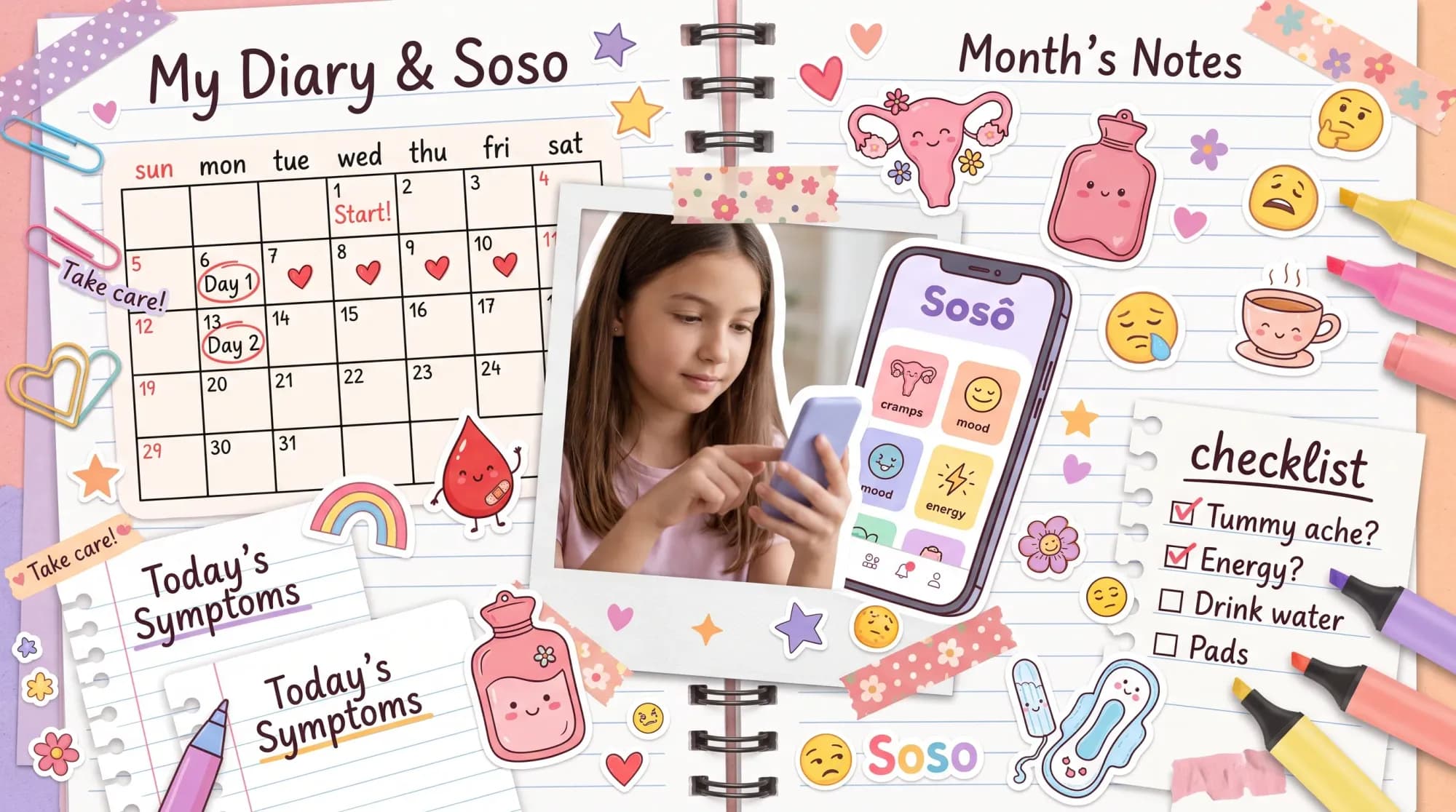
Period symptoms: what they are and how to track them
Cramps, bloating, tiredness, headaches, and other changes can happen before or during your period. Learn what you might feel and how to track everything in Soso.
Soso Answers: Breast Growth, Body Comments and Brain Changes (September 30 to October 7)
This week you asked whether breasts can grow faster, what to say when a friend says her body is better than yours, whether you can get ready for PMS, what to do when your mum keeps saying no to a period kit, and whether your brain changes at puberty. Here are the real answers.
Soso Answers: Gel Discharge, Pink Blood and Tampon Trouble (September 16 to 23)
This week you asked about gel-like discharge that soaks through, a first period in white trousers, pink blood on day one, a tampon that hurts once it is in, and how many days there should be between periods. Here are the real answers.