
First Period Products for Girls: A Buying Guide for Moms
Find out how to choose the right product for her flow and routine, what can wait and what to avoid for your daughter’s first period.
Your daughter is close to her first period or has already started. You walk into the aisle and run into dozens of packages: thin pads, overnight pads, pads with wings, period underwear, menstrual cups.
I’m writing this guide to help you choose a first pad for your daughter without wasting money.
Here you’ll see what each product is, which one makes sense in each situation, what to buy first, what can wait and what to avoid.
What the First Period Usually Looks Like (and Why to Start Small)
The first period is usually a spot, not a flood. The NHS describes it as a reddish-brown spot on underwear or bedsheets, and the Cleveland Clinic says it’s often light at first.
So you don’t need to buy a lot at once. A small pack of each type, for her to try, is usually better than a big pack of just one.
Her flow and her cycle rhythm will still change. In the first two years, cycles usually last about 21 to 45 days, and a period can be light one month and heavier the next (Hillard, 2008). What works today may not work six months from now.
READ MORE | Irregular Menstrual Cycle in Adolescence: Is It Normal?
The Products, One by One
All usage tips below are curated by Soso, supported by the medical sources cited at the end.
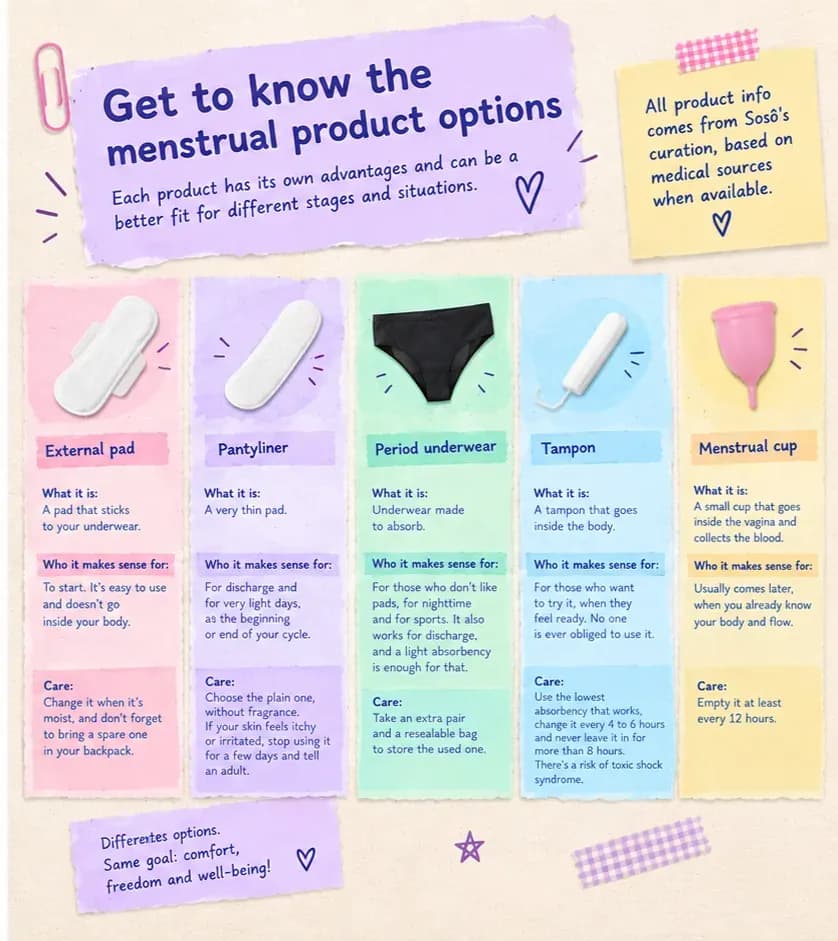
Pad
- What it is: a pad that sticks to her underwear.
- Who it makes sense for: to start with. It’s simple to use and doesn’t go inside the body.
- Watch out: change it when it feels damp, and don’t forget to put a spare in her backpack.
Panty Liner
- What it is: a very thin pad.
- Who it makes sense for: days with discharge and very light days, at the start or end of a period.
- Watch out: choose a plain one, with no fragrance. If her skin gets itchy or burns, stop using it for a few days and tell an adult.
Period Underwear
- What it is: underwear made to absorb.
- Who it makes sense for: girls who don’t like a pad stuck on, plus overnight and sports. It also works for discharge, and a light-absorbency pair is enough for that.
- Watch out: carry an extra pair and a resealable bag for the used one.
Tampon
- What it is: a product that’s placed inside the vagina.
- Who it makes sense for: girls who want to try one when they feel ready. She’s never required to use one.
- Watch out: use the lowest absorbency that works, change it every 4 to 8 hours, and never leave one in for more than 8 hours. There’s a risk of toxic shock syndrome. Here at Soso, we have a detailed article on tampons.
Menstrual Cup
- What it is: a small cup worn inside the vagina that collects the blood.
- Who it makes sense for: it’s usually left for later, when she already knows her own body and her flow well.
- Watch out: empty it every 8 to 12 hours.
Which Product to Choose by Flow and Situation
Situation
To start with
Watch out
First spot, pink or brown
Thin panty liner or thin pad. Tell your daughter to put a pad on as soon as she sees pink, because the flow often increases the next day
A leak when she didn’t know it had started is common
Light days, at the start and end
Panty liner, thin pad or light period underwear
Choose fragrance-free products
Heavier flow days
Regular pad or period underwear
Needing to change every 1 to 2 hours is a sign to see a doctor
Night
Pad or period underwear
Never leave a tampon in for more than 8 hours
Sports
A pad works well
Carry a spare
Swimming
Period swimwear. A pad doesn’t work in water
She doesn’t need a tampon to swim
School
A mini kit in her backpack: a pad, extra underwear and a resealable bag
See the kit guide
Discharge with no period
Plain panty liner or light period underwear
If it changes color, smell or texture, tell an adult
How to Read the Package
- Size: packages use names like thin, regular, long and overnight. Start with regular and adjust as she uses them.
- Absorbency: use the lowest one that works. The FDA advises this for tampons and says that if she can go up to 8 hours without changing, the absorbency may be too high.
- Wings: wings help hold the pad in place on her underwear. It’s a matter of her comfort.
- Fragrance: choose fragrance-free products. The NHS advises avoiding scented products in the intimate area, because they can cause irritation.
- Quantity: a small pack of each type, for her to try.
What to Buy First, What Can Wait and What to Avoid
Buy First
- One pack of pads.
- One pack of plain, fragrance-free panty liners.
- One pair of period underwear, for her to try.
- One extra pair of dark underwear and a resealable bag for her backpack.
Can Wait
- Tampons: only if she wants to, after a conversation.
- Menstrual cup.
- Large stockpiles of just one type, before you know what works for her.
Avoid
- Scented products, like wipes, sprays and scented intimate washes. They can upset the natural balance and make irritation worse.
- A tampon with more absorbency than her flow calls for.
- Leaving a tampon in for more than 8 hours.
- Using an internal product to sleep for more than 8 hours. At night, prefer a pad or period underwear.
When to Get Medical Care?
When to Get Emergency Care
If your daughter uses a tampon or a cup and feels very unwell, take the product out and get urgent help. These can be signs of toxic shock syndrome, which is rare:
- High fever, or feeling hot, cold, or having chills
- Muscle pain, or severe pain in the arms or legs
- Rough skin, like sandpaper, when you run your hand over her skin. Redness can be harder to see on Black or brown skin, so it’s worth feeling it with your hand
- Swollen or peeling skin
- Very red palms, soles of the feet, tongue, or whites of the eyes
- Vomiting or diarrhea
- Dizziness, nausea, or confusion
- Flu-like symptoms
What to do:
- Remove the tampon or the cup.
- Tell the doctor she was using one. It’s the most important information because it leads to the diagnosis.
- Get medical care immediately.
Also get immediate medical care if she has dizziness, a feeling of fainting, or a racing heart along with heavy bleeding.
When to Talk to an Adult and Book an Appointment?
Encourage your daughter to tell a trusted adult the same day, and book an appointment if any of these happen:
- She needs to change her pad every 1 to 2 hours.
- A period that lasts more than 7 days.
- Clots larger than about 2.5 cm (about 1 inch).
- Blood that soaks through to her clothes or bedding.
- Missing activities because of her period.
- If a tampon hurts every time she tries one, even when it’s inserted far enough, stop using it and see a doctor.
For more signs, read our article on when to see a doctor.
How Does Soso Help Her Not Leave Home Without Her Kit?
Soso is rated 9+ and is written entirely in the voice of the real-life Soso. It can discreetly let her know when her next period is near, so she remembers to put her kit in her backpack.
That alert is an estimate, not a promise. In the first years, the cycle still varies, so it’s worth keeping the kit always ready. The app supports your conversations, it doesn’t take their place.
Your daughter can also log what she used and how she felt. That helps her notice what works best for her.
Buy Together With Her
The best first pad is the one she feels good using. Take your daughter shopping, let her choose between two or three types and talk about what she prefers. If she feels comfortable, she’ll use it.
Want to know if her kit is ready? She can take the school survival kit quiz. And if you’d like to get to know the app, download Soso and explore it together.
Important notice: this content is for information and education only. It does not replace advice, diagnosis, or treatment from a healthcare professional. If your daughter has any of the signs listed above, see a doctor and, if needed, get urgent care.
Frequently Asked Questions
How many pads should I buy for the first period?
Start with a small pack of each type for her to try. Then buy more of what she uses most.
Can my daughter use a tampon for her first period?
Tampons are never required. Pads and period underwear work just as well. If she wants to try one, read our article to better understand how tampons work in the first period.
Does period underwear work for discharge too?
Yes. It’s made to absorb liquid, and a light-absorbency pair is enough for discharge.
Can I buy scented pads?
Choose fragrance-free ones. The NHS advises avoiding scented products in the intimate area, because they can irritate.
Sources
- NHS. “Starting your periods”. https://www.nhs.uk/conditions/periods/starting-periods/
- NHS. “Periods”. https://www.nhs.uk/conditions/periods/
- Cleveland Clinic. “Menarche”. https://my.clevelandclinic.org/health/body/menarche
- US Food and Drug Administration. “The Facts on Tampons and Tampon Safety”. https://www.fda.gov/consumers/consumer-updates/facts-tampons-and-tampon-safety
- NHS. “Toxic shock syndrome”. https://www.nhs.uk/conditions/toxic-shock-syndrome/
- NHS. “Heavy periods”. https://www.nhs.uk/conditions/heavy-periods/
- American Academy of Pediatrics, HealthyChildren.org. “How to Use Tampons, Menstrual Cups & Other Period Products Safely”. https://www.healthychildren.org/English/ages-stages/gradeschool/puberty/Pages/How-to-Use-Tampons-and-Menstrual-Cups-Safely.aspx
- Hillard PJA. “Menstruation in Adolescents: What’s Normal?”. The Medscape Journal of Medicine, 2008. https://pubmed.ncbi.nlm.nih.gov/18574205/
- Soso. Menstrual Products Guide. https://www.sosoapp.com.br/en/learn/menstrual-products-guide
- Soso. Medical Sources Page. /en/medical-sources
Comments (0)

Veronica Tarsitano is a nursing student and a Brazilian living in Portugal. Married and a mother of three, including the girl who inspired the name "Sosô". She writes based on the real-life experience of closely following a daughter's first period, without filters.
Download the Soso app and put this into practice
Download the appRelated Posts

Can you use tampons for your first period? Myths and facts
Tampons can be an option from your very first period. Learn how they work, whether they can hurt, and what you need to know to use them safely.

When should I see a doctor? A guide for girls who have started their periods
You don't need to see a gynecologist just because you've started your period, but some signs, like very strong pain or heavy bleeding, are worth talking about with an adult and getting checked by a doctor.
Period symptoms: what they are and how to track them
Cramps, bloating, tiredness, headaches, and other changes can happen before or during your period. Learn what you might feel and how to track everything in Soso.