Soso Answers: Secrets Getting Out, Body Hair and Hungry Days (August 28 to September 3)
This week you asked what happens when someone shares your period news without asking, where the blood actually comes from, why you get cramps with no period in sight, whether hair always comes first, and what to eat when you are hungry all the time.
Some weeks the questions arriving in Soso are mostly about blood and pads. This week they were mostly about knowing. Girls wanted to know what their body was actually doing, not just whether it was allowed. Several of you asked where the blood really comes from and what the stringy bits are. Several asked why you get cramps on days when there is no period anywhere. Several asked whether hair always shows up first, and what it is even for. And one of you asked what to do when a brother tells the whole school something you never gave him permission to share.
That last one is where we are starting, because it was the question that clearly hurt the most.
Here are five real questions from the week of 28 August to 3 September, answered properly.
Q1. Someone told other people about my period without asking me. What do I do now?
Several girls asked about this from different angles this week. One had a brother who told people at school. One wanted to know whether to tell her best friend. One was working out who to tell first, before anything had even happened. And one had a friend who had announced a plan for when her own period would arrive, which is not how it works, and wanted to know what to say.
They are all really the same question: who gets to know about my body, and what happens when I do not get to choose?
What is going on
Two things are happening at once, and it helps to pull them apart.
The first is a privacy thing. Information about your body is yours. When someone passes it on without asking, they took a decision that was yours to take. That would be worth being upset about even if the information were completely boring.
The second is a stigma thing. The reason it feels so exposing is that a lot of cultures treat periods as something to hide. That is not a fact about periods. It is a habit people learn.
The difference changes who the problem belongs to. If you think your body did something embarrassing, you carry it. If you understand that people around you learned to react oddly to an ordinary thing, you carry much less.
What the research actually says
In a well-known experiment by Roberts and colleagues, published in 2002, a woman dropped either a tampon or a hair clip out of her bag in front of other people. When it was the tampon, observers rated her as less competent, liked her less, and tended to sit further away. Nothing about her changed. Only the object did. The awkwardness in the room is about the object, not about you.
Johnston-Robledo and Chrisler, reviewing accounts from many cultures, describe girls' stories of their first periods as marked by secrecy and concealment, with negative feelings outweighing positive ones. So if hiding it felt like the obvious move, that is the pattern almost everyone is taught.
On teasing specifically, the most useful study we found is Benshaul-Tolonen and colleagues in PLOS ONE in 2020. They surveyed 432 boys and 524 girls, average age around 15, across four secondary schools in northern Tanzania. Thirteen per cent of the girls said they had actually been teased about periods. More than eighty per cent said they feared being teased. Girls named male classmates as the most feared source, at 46 per cent, then female classmates at 34 per cent, then teachers at 10 per cent.
Read those two numbers next to each other, because the gap is the point. Far more girls were braced for it than had experienced it. The dread is much more common than the event.
One more finding from that study, and it is an uncomfortable one. The researchers tested the boys' knowledge about periods and found no significant relationship between how much a boy knew and whether he teased. That means "he just does not understand" is probably not the whole explanation, and explaining harder is probably not the whole fix.
Do not stretch these numbers too far. This was four schools in two districts of one country, picked for convenience rather than to be representative, and the authors say so themselves. Some students skipped the sensitive questions. It tells you the pattern exists and has been measured. It does not tell you the odds at your school.
There is a hopeful finding too. Marván and colleagues, studying 405 Mexican girls aged 12 to 15, found that only 39 per cent felt prepared for their first period, and that girls who had talked about the emotional side with their mothers beforehand were far more likely to say they felt prepared. That is one study in one country, and it shows the two things go together rather than proving one causes the other, but it is a good reason to have the conversation early.
What to do about it
- Say the actual sentence to the person who shared it. Not a fight, one sentence: "That was mine to tell. Do not do that again." If it was a brother, add: "If you want to know something about me, ask me, and I will decide."
- Decide your public version before anyone asks. Pick one flat, boring reply and use the same one every time. "Yeah, so does half the school." "Yep. Anyway." A calm, flat reply then walking away is what paediatricians suggest: say your line, do not get drawn in, and go. It does not always stop it, which is exactly why step 3 is not optional. Practise it out loud twice so it comes out steady.
- Tell one adult, even if you handle the rest yourself. Not so they can storm in, but so that if it keeps going you are not starting the story from scratch. "Something about me got shared at school and I want you to know in case it carries on."
- Pick your next person deliberately. If you want to tell a best friend, tell her on purpose, in a quiet moment: "I got my period. I am telling you because you are my person. Please keep it between us." Choosing is the part that was taken from you. Take it back.
- Do not audit your own behaviour for what gave it away. Nothing you did caused this. Someone made a choice.
A worked example
Your brother told a group at school on Monday. By Tuesday two girls have asked you about it.
Monday evening you find him alone and say the sentence: "That was mine to tell. Do not do that again." He says he was only joking. You say, "I know. Do not do it again." Then you stop. You do not need him to agree, you need him to have heard it.
Tuesday morning you pick your line: "Yep, ages ago. Anyway, did you do the maths?" You say it to the mirror twice. When the first girl asks, you use it and immediately ask her something else. She moves on, because there was nothing to hold on to. That evening you tell one parent: "Just so you know, my brother told people at school. I have dealt with him. I am telling you in case it keeps going."
Often it fades within a week or so, and it almost never feels on Monday like it will. If it does not fade, that is not you failing at it, and the list below is what to do next.
When it is more than an awkward week
Some of this stops being a thing you manage on your own. Tell an adult by name, and keep telling them until something changes, if:
- it keeps going after you have asked it to stop
- it moves into group chats, photos or anything online
- you are changing what you do to avoid it, such as skipping lessons, dropping an activity, or not going to the toilet at school
- more than one person has joined in
And if the feelings around it get so big that they scare you, or you do not feel able to keep yourself safe, that is the moment to tell a trusted adult straight away rather than waiting for a better time.
Q2. Where does the blood actually come from, and what is that stuff in it?
This was the week's biggest cluster of pure curiosity questions. One of you asked where the blood leaks from. One asked what the stuff is that comes out along with it. One asked how the blood can contain an egg when you cannot see one. And one asked how you would tell a period apart from bleeding from your bottom.
Good questions, all of them, and nobody had given straight answers.
What is going on
Start with the plumbing, because a lot of confusion lives here.
Between your legs there are three separate openings, front to back. The urethral opening, where wee comes out, sits just below the clitoris. Below that is the vaginal opening, where period blood comes out. Further back and completely separate is the anus, where poo comes out. Three openings, three jobs, no crossover.
Now the blood itself. Inside your uterus there is a lining called the endometrium. Across your cycle it thickens into a soft cushion. If no pregnancy happens, that lining is not needed, so it comes away and leaves through the cervix and the vagina. The blood comes from the small vessels in that lining as it separates.
So the honest answer to "what is that stuff" is: period flow is not just blood. It is the lining itself, plus blood from the vessels in it, plus the normal mucus your cervix and vagina always make. That is why it is thicker than blood from a cut, why the texture changes across the days, and why you sometimes see darker, jelly-like pieces.
Cleveland Clinic's description of the endometrium gives you the scale: around 16 to 18 millimetres thick just before a period, and 1 to 4 millimetres during one. Something about as thick as your little fingernail is wide comes down to something about as thick as a couple of stacked coins. That is a real amount of material, which is why what comes out has substance to it.
And the egg. The egg is a single cell. It is the biggest cell in your body, about a tenth of a millimetre across, which means you could just about see one as a speck if it were sitting on your finger. But you will not, because the egg is not in your period at all. If an egg was released, it broke down within about a day, roughly two weeks before the bleeding started. The period is the lining coming away afterwards. You are not failing to spot the egg. It is not there to find.
Worth saying plainly too: in the first year or two after a first period, most cycles do not release an egg at all, and the period still happens.
What the research actually says
On clots, the most direct answer comes from Cleveland Clinic, where the obstetrician and gynaecologist Salena Zanotti explains that clots form whenever a certain amount of blood sits still for a while before it leaves. She describes clots roughly the size of a small coin as normal on heavier days. What she flags as a problem is passing golf-ball-sized clots every couple of hours, or soaking through a pad in an hour. The NHS sets the line a little earlier, at changing a pad every one to two hours, and that is the one to use.
The NHS gives the same boundary in measurements rather than coins, which is more useful because coins differ everywhere: clots bigger than about 2.5 centimetres are worth mentioning to an adult, alongside changing a pad every one to two hours, periods running longer than seven days, bleeding through to clothes or bedding, feeling tired or breathless a lot, and avoiding normal activities because of your period.
One thing the NHS is clear about that is easy to miss: very heavy bleeding right from the very first period can be the first sign of an inherited bleeding condition. That is worth raising even when nothing else seems unusual. It is a findable thing, and much easier to sort out once someone knows.
What to do about it
- To tell period blood from other bleeding, check the source, not the colour. Period blood arrives on the front part of your pad or underwear. Bleeding from your bottom shows up on the toilet paper when you wipe after a poo, or as streaks on the poo itself.
- Check whether it fits a pattern. Period bleeding runs for days and changes as it goes: heaviest in the first two days or so, and often browner right at the start and at the end. Bleeding from a small tear usually happens at one moment, connected to something, like going to the toilet when you were constipated.
- Track what you actually see, not what you assume. In Soso, log the day, roughly how heavy it was, and anything unusual such as a clot bigger than about 2.5 centimetres. A week of notes turns "I think it was weird" into something a doctor can act on.
- Do not panic about texture. Stringy, jelly-like, darker at the start and end, all normal. It is lining, not damage.
- If you think the blood is coming from your bottom, say so to an adult. It usually turns out to be something small and fixable, and it is not a thing to sit with quietly for weeks.
A worked example
You go to the toilet, wipe, and see blood, and you genuinely do not know which kind it is.
Fresh paper, wipe once, look at where the colour sits. It is at the front. You put on a pad, note the time in Soso, and get on with your day. Four hours later there is more, browner than before. That is a pattern with a shape to it, and it is behaving like a period.
Different version: it only shows up on the paper after a difficult poo, there is nothing on the pad by the evening, and your last period was two weeks ago. Different story, and that one goes to an adult.
Either way, you found out by looking and writing it down, instead of worrying about it for four days.
When it is more than an ordinary period
Tell an adult, and ask about seeing a doctor, if:
- you are changing a pad or tampon every one to two hours
- your period runs longer than seven days
- you are passing clots bigger than about 2.5 centimetres
- you are bleeding through onto clothes or bedding
- you often feel tired or out of breath
- you are skipping things you want to do because of your period
- you think the bleeding is coming from your bottom rather than your vagina
Q3. Is it normal to have cramps when I am not on my period?
Four of you circled this one. One asked directly whether cramps count as normal when there is no period. One described sore breasts, discharge and mild cramps arriving together. One had asked her mum what a period cramp is and been told it is different from the cramp you get running, which is true, and wanted to know how. And one wanted to understand the difference between a small ache and a properly intense cramp.
What is going on
Your uterus is a muscle, and it is not a muscle that waits politely for day one.
Chemicals called prostaglandins make the uterus contract so the lining can come away. They do not appear the moment blood does. They build first. That is exactly why pain relief for period pain works best started before the bleeding rather than after. So cramps a day or two before anything shows up are the ordinary version of this, not a mystery.
Second: not everything that feels like a cramp down there is your uterus. In the second half of your cycle, progesterone relaxes smooth muscle, including the muscle in your gut, so things move more slowly and you feel bloated and heavy. Then, around the period, prostaglandins speed the gut back up. That handover is why bloating so often turns into a looser tummy on day one, and why a lot of "cramps" are honestly your intestines.
Third, and this answers your mum's point exactly. A cramp from running is a skeletal muscle cramp: a muscle you control, seizing, in one obvious spot, and you can usually stretch it out. A period cramp is smooth muscle: muscle you do not control, deep inside, felt as a dull spreading ache low in your belly that often runs into your lower back or the tops of your legs. You cannot stretch it away because you cannot reach it. Your mum was right.
Fourth: mid-cycle pain. Around the time an egg is released, some people get a one-sided ache low in the belly. It has a name, mittelschmerz, which is German for "middle pain".
What the research actually says
On mid-cycle pain, the StatPearls review by Brott and Le says it may affect over 40 per cent of women of reproductive age, that it happens somewhere between days 7 and 24 of a cycle, that it usually settles within three to twelve hours, and that it is generally felt on the same side as the ovary getting ready to release an egg.
One detail in that review matters enormously here and most articles leave it out. Mittelschmerz does not usually begin until a few years after a girl's first period, once cycles are properly ovulatory. And there is general agreement in the research that in the first year or two after a first period, most cycles do not release an egg at all. So if you have not started your periods, or only started recently, ovulation pain is one of the *less* likely explanations for a random ache. Constipation is worth ruling out first. But there is one pattern that is different: if you have never had a period and you get a cramp that comes back at roughly the same time each month, tell an adult and ask to see a doctor. There is a blockage that causes exactly that pattern, it is not rare enough to ignore, and it is found by an examination rather than by waiting. It is fixable. It just needs someone to look.
On the gut, Bernstein and colleagues surveyed healthy women in 2014 and found 73 per cent reported at least one gut symptom before or during their period, and 31 per cent reported several. Bloating was reported by 62 per cent before their period and 51 per cent during; abdominal pain by 58 per cent before and 55 per cent during. Notice how many of those are before. Belly symptoms in the run-up are the normal case, not the odd one.
On when period pain itself starts, McKenna and Fogleman's review says ordinary period pain typically begins on average six to twelve months after a first period, tracking the point where cycles start releasing an egg. Having no cramps at first and developing them later is a recognised sequence, not a warning.
That same review draws a boundary worth knowing. Pain that turns up much later out of nowhere, or pelvic pain that keeps getting worse over time, especially alongside unusual bleeding or a change in discharge, is described differently and needs a doctor rather than a hot water bottle.
On what helps, a meta-analysis by Jo and Lee pooled six randomised trials of heat. In the three that compared a heating pad directly against pain medication, heat did at least as well, and better in some analyses. The reviewers say plainly that these were few trials with small numbers of participants, so treat it as encouraging rather than settled.
On exercise, Xiang and colleagues in 2025 describe the amount that was actually studied: more than three sessions a week, over 30 minutes each, adding up to at least 90 minutes a week, kept up for at least eight weeks. That is prevention over weeks. One walk on a bad day is not what was tested, so do not judge exercise by how a single walk feels.
What to do about it
- Log the day of your cycle, not just the pain. In Soso, note the date and where you are in your cycle. After two or three months a shape appears: always four days before, always mid-cycle, always after a big meal. The shape is what tells you what it is.
- Try heat. A heat pad on a low setting, or a hot water bottle wrapped in a tea towel so it is never against bare skin, on your lower belly or lower back. The trials that tested this used gentle heat kept on for several hours, not a quick blast. It is one of the better-evidenced things you can do for yourself, though the reviewers say plainly that the trials were few and small.
- Rule out the boring explanation. Have you been to the toilet properly in the last two days? Constipation causes an enormous amount of "unexplained" belly cramping. Water, fruit and moving around are not exciting, but they are the answer more often than anything else.
- Build the exercise habit outside the painful days. Three or four sessions a week of anything you will actually keep doing, half an hour or more: walking, dancing, swimming, football. Judge it after two months, not after one afternoon.
- If pain relief is being discussed, the timing principle is the part to know: it works better started before the bleeding than once the pain is bad. An adult decides which medicine and how much, based on your age and weight. That is not a decision to take from an article or a friend.
- Learn the words for how bad it is, because "it hurts" gets you less help than it should. Try: "It is a dull ache I can ignore," or "It is bad enough that I cannot concentrate," or "It stops me doing things." Adults respond very differently to the third one, and they should.
A worked example
You get a low ache on a Tuesday with no period in sight. Instead of guessing, you open Soso and write: Tuesday, dull ache low in the middle, not too bad, also bloated, last period started 18 days ago.
Wednesday it is still there and you notice you have not had a poo since Sunday. You drink more water, eat some fruit, walk to the shop. Thursday it is gone.
Next month, roughly the same day, it happens again. Now you have a pattern instead of a fright, and if you ever do want to ask a doctor, you have two months of notes rather than a shrug.
When it is more than ordinary cramping
Some belly pain needs an adult the same day, not a hot water bottle. Get help now if:
- the pain is on one side and keeps getting worse rather than easing
- it comes with a fever, being sick, or pain when you press on your belly and let go
- it stops you standing up straight or walking normally
And ask for a doctor's appointment, without rushing, if:
- you get cramps that come back month after month but you have never had a period
- the pain is worse than your usual, or it is stopping you doing normal things, and the usual measures are not touching it
Ovulation pain settles within hours. Pain that ramps up over a day, especially on one side with a temperature, can look very similar to appendicitis, and doctors take that seriously precisely because the two get confused.
And book time with a doctor, without rushing, if pelvic pain is slowly getting worse month after month, or if it arrives alongside bleeding that is not like your usual bleeding, or discharge that has changed.
Q4. Does everyone get hair down there before their first period, and what is it even for?
Three of you asked versions of this. One wanted to know whether every girl gets pubic hair before her first period. One asked where hair is normal generally. And one asked, brilliantly, why we have hair down there at all, and whether it is for protection.
What is going on
Puberty is not one switch. It is two, and they are wired to different places.
Adrenarche is your adrenal glands, which sit on top of your kidneys, turning up their production of androgens. That is what drives pubic hair, underarm hair, a new body smell, oilier skin and hair, and spots. It typically gets going around ages six to eight, quietly, years before anything visible happens.
Gonadarche is your ovaries switching on and producing oestrogen. That is what drives breast development, and eventually periods.
Two different glands, two different sets of hormones, two different timers. That is the whole reason the order varies between girls: they are not on the same clock. Hair arriving before breasts, or after, or at the same time, is not a sign of anything going right or wrong. It is two systems that were never synchronised in the first place.
What the research actually says
The best study for your exact question follows a large British group of children. Christensen and colleagues, in the International Journal of Pediatrics in 2010, tracked 3,938 girls in the Avon Longitudinal Study of Parents and Children and sorted them by which came first:
- 46.3 per cent developed breasts and pubic hair at roughly the same time
- 42.1 per cent started with breast development
- 11.6 per cent started with pubic hair
So starting with hair is genuinely a minority route, but it is not rare either: about one in nine. And the two other groups together mean roughly nine in ten girls had some breast development before or alongside the hair.
One caution about those numbers. Girls and their parents judged the stages themselves from diagrams, on questionnaires sent about once a year, and the authors point out that a year is long enough to miss which change really came first. The girls were also mostly white and British and born in the early 1990s. So read this as "all three routes are common", not as exact odds.
On timing, in that same group the median age for reaching pubic hair stage 2, meaning the first sparse hairs, was 10.95 years, and the median age at first period was 12.87 years: a gap of nearly two years for the group as a whole. That is why hair usually shows up well before a first period. The study did not count how many individual girls got their period before any hair at all, so nobody can honestly tell you it is "always", only that hair first is by far the usual pattern. Girls on the hair-first route reached their first period a little later, with a median of 13.13 years against 12.78 for the breasts-first group.
Now the honest part, because you asked what it is for and you deserve a straight answer rather than a confident guess. Nobody actually knows. There are hypotheses: that it reduces friction between skin and skin, that it helps hold warmth, that it holds scent from the sweat glands that switch on in the same area at the same time. None of them has been tested well enough to count as a finding, and we could not find a good study that settles it.
So if someone tells you confidently that pubic hair is definitely for protection, they are giving you a plausible story, not a proven fact. "Scientists are not sure" is the true answer, and a much more interesting one.
What we can say with confidence is what it means: your adrenal glands are doing their job, on schedule.
What to do about it
- Nothing. Genuinely nothing. There is no care routine required. Wash with water when you shower, the same as the rest of you.
- Expect it in more places than one. Hair thickening or appearing on your legs, underarms, forearms, upper lip, around your nipples, and in a line below your belly button is all part of the same hormone shift. How much you get is mostly down to your genes and your family background. A bit of hair in those places is ordinary. If hair on your face, chest or belly is noticeably increasing month on month, or it turns up alongside periods that are all over the place or acne that is not shifting, mention it to an adult so a doctor can check the hormone side. It is common and treatable, and not something you have to put up with quietly.
- Do not compare timing with your friends. You are watching several completely different timers and only one of them is yours. A friend with more hair is not further ahead in any race that exists.
- You do not have to remove any of it. Shaving and waxing are choices, not maintenance. If it is something you want to think about, talk it through with an adult you trust first, because the practical details matter more than people admit.
- Do not use hair removal creams there, and do not use products meant for the hair on your head. The skin is different and much more easily irritated.
- If the hair itself is what is bothering you, say so out loud to someone. "I do not like this" is a reasonable thing to feel, and easier to carry once it is said.
A worked example
You are eleven. You noticed a few hairs a while ago, your chest has not really changed, and a friend the same age has clearly started developing while you have not.
The Christensen numbers say roughly where you are: you are in the group where hair came first, about one in nine girls, and girls on that route tended to reach their first period a few months later than average. Nothing is late. Nothing is wrong. You are on a common route that is simply less talked about, because most puberty explanations describe the most common route and stop.
What you actually do is nothing, except perhaps note in Soso when you first noticed changes, so that when your first period does arrive you have your own timeline rather than a guess.
When it is more than ordinary timing
Two situations are worth mentioning to an adult so a doctor can take a look.
Pubic hair or underarm hair appearing before around age eight, particularly if it is arriving alongside breast development, a growth spurt, or body odour. Doctors use age eight in girls as the point where they look more closely. In many cases hair on its own before that age turns out to be a benign early version of the same normal process and needs nothing but keeping an eye on. It is checked because there are less common causes worth ruling out, not because something is presumed wrong.
Changes moving very fast, at any age. If pubic and underarm hair, a growth spurt and breast changes are all arriving within a few months rather than over a couple of years, tell an adult and ask for a doctor's appointment. Doctors check the speed of puberty as well as the age it starts. The same goes at any age for a voice that is getting deeper, hair that is arriving very quickly, or acne that is sudden and severe.
Q5. I am hungrier than usual, and everyone tells me to eat iron. What should I actually eat?
This one arrived from four directions. One of you asked whether it is normal to eat more and more in the run-up to a period but not during it. One asked whether cravings right after a period are okay. One asked which food has the most iron out of all foods. And one asked, very specifically, whether grapes have iron that helps with periods.
What is going on
Two separate things, and they get mixed up constantly.
The hunger part. In the second half of your cycle, after an egg would be released and before a period, progesterone rises, and progesterone tends to push appetite up. Oestrogen, higher in the first half, tends to push it down. Your resting metabolism, the energy your body uses just existing, may also tick up slightly in that second half, though the research on that is weaker than it sounds: when only the newer, better-run studies are counted, the difference stops being reliable. Still, that is a real reason many people feel hungrier in the week or so before a period and normal again once it starts, which is exactly the pattern one of you described.
The iron part. Blood contains iron, so when you bleed each month some iron leaves with it. At the same time you are growing, and growing bodies need iron to build blood and muscle. Those two demands land at once during your teens, which is why iron comes up so much around periods.
They are separate mechanisms. Being hungry is not your body asking for iron, and iron is not a cure for cravings.
What the research actually says
On appetite, be careful, because the confident version you usually hear is more confident than the evidence.
The best summary is a systematic review and meta-analysis by Tucker and colleagues, published in Nutrition Reviews in 2024. Pooling 15 datasets covering 330 participants, they found energy intake was higher in the second half of the cycle than the first, by roughly 168 calories a day.
Now the caveats, which the authors raise themselves and which matter more than the headline. The studies disagreed with each other a great deal, which they quantify as an I-squared of 83 per cent. They describe repeated methodological inconsistencies and large variability in how researchers even decided which phase a participant was in. Only four of the studies had high-quality measurement. And critically, every participant was an adult aged 18 to 45. Girls under 18 were deliberately excluded.
So the honest position is: on average, adult women in these studies ate somewhat more in the second half of their cycle, individual differences were large, the studies disagree a lot, and nobody in the research was your age. Feeling hungrier before your period is common and there is real evidence behind it. Nobody has measured the exact number for a twelve year old, and anyone who gives you a precise figure is making it up.
On iron the evidence is much more solid, and there is a study on girls your exact age. Moschonis and colleagues studied 1,222 Greek girls aged 9 to 13 in the Healthy Growth Study. Among girls who had started their periods, 33.5 per cent showed iron depletion. Among girls who had not started, it was 15.9 per cent. Girls who had started were about 2.57 times more likely to be iron depleted, and after accounting for other factors, having started periods was the only thing that significantly raised the likelihood.
That is roughly one in three of the menstruating girls in that study, so this is common rather than exotic. It is one study in one country, so do not read it as your personal odds, but it is a good reason to take the food side seriously.
On which foods, here is the part almost nobody explains. There are two kinds of dietary iron and they behave completely differently. Moustarah and Daley's StatPearls review on dietary iron reports that about 25 per cent of heme iron is absorbed, compared with 17 per cent or less of non-heme iron.
- Heme iron, the well-absorbed kind, is in red meat, the darker meat of chicken and turkey such as thighs and drumsticks, fish, and shellfish.
- Non-heme iron, the less well-absorbed kind, is in beans and lentils, dark leafy greens, nuts, seeds, whole grains, dried fruit, and fortified breakfast cereals.
The same review explains that vitamin C boosts absorption of non-heme iron and counteracts the things that block it: phytates in grains and beans, polyphenols in tea and coffee, and calcium in dairy.
So "which food has the most iron" turns out to be the wrong question. Liver is famously iron-rich, but it is not the top of the list: per serving, fortified breakfast cereal, shellfish such as oysters and clams, and a cup of white beans all carry more iron than a serving of liver. And the food that puts the most iron into you depends on the kind of iron and what you eat alongside it. Beans with a squeeze of lemon can beat beans with a glass of milk.
And grapes, since you asked directly: grapes are not an iron food. They are mostly water and sugar, and their iron content is tiny next to beans, meat or fortified cereal. Raisins are dried grapes, so the same iron is concentrated into a smaller mouthful, which makes them a reasonable snack. A bowl of grapes is still a perfectly good thing to eat. It just is not the thing you were told it was.
What to do about it
- Eat when you are hungry in the week before your period. This is not a willpower failure. Adding a proper snack is a sensible response to a body using slightly more energy.
- Make the snack one that holds. Protein or fat lasts longer than pure sugar: peanut butter on toast, yoghurt with fruit, cheese and crackers, hummus and carrot sticks, a handful of nuts.
- Put an iron food into one meal a day. Not every meal, one. Beans in a wrap. Lentils in a soup. A fortified breakfast cereal. Sardines on toast. Pumpkin seeds on top of something. Red meat twice a week if you eat it.
- Pair plant iron with vitamin C, every time. Orange segments, strawberries, tomatoes, red peppers, broccoli, a squeeze of lemon or lime. Beans and salsa. Lentils and tomato. Cereal and orange juice. This is the highest-value habit in this whole section and it costs nothing.
- Move tea and coffee away from your iron meals. The polyphenols in them block non-heme iron absorption, so have them between meals instead of with them. The same goes for a large glass of milk alongside a beans-and-rice dinner.
- Do not take iron supplements unless a doctor has said to. The NHS warns that very high doses of iron can be fatal, particularly if taken by children. Iron is not something to top up just in case. If you think yours is low, the answer is a blood test, not a bottle from a shop.
- If you are tired all the time, ask for the blood test by name. "Can I get my iron checked?" is a completely normal request for a girl with periods, and doctors are not surprised by it.
A worked example
Monday you are ravenous by 4pm, and your last period started 22 days ago. Instead of arguing with yourself, you eat: toast with peanut butter, an apple. You note in Soso that you were hungrier than usual.
Tuesday breakfast is a fortified cereal with a glass of orange juice next to it. That is the vitamin C trick, done without thinking about it. Wednesday dinner is a bean chilli with tomatoes and a squeeze of lime, which is three things working together. Thursday you are hungry again, so you have yoghurt and berries after school rather than waiting and then eating everything in the cupboard at seven.
Friday your period starts, and by Saturday the hunger has settled on its own, exactly as it did last month. Because you wrote it down, you now know this is your pattern and not a new problem.
That is the whole thing. One iron food a day, vitamin C alongside it, and eating when you are hungry.
When it is more than a big appetite
Book time with a doctor, with an adult's help, if:
- you are tired in a way that sleep does not fix, week after week
- you get out of breath going up stairs you used to manage easily
- you look unusually pale, or feel dizzy when you stand up
- your periods are heavy by the signs listed earlier in this post, since heavy bleeding and low iron travel together
And separately: if eating starts to feel out of your control, or thinking about food is taking up a lot of your day, that is worth telling a trusted adult about. It is not a thing to sort out alone, and it has nothing to do with how much willpower you have.
The bottom line
The thread running through this week is that you were all asking how, not just whether.
Not "is it normal to have cramps", but how a period cramp is different from a running cramp. Not "do I have hair", but what the hair is for and why it comes when it does. Not "am I allowed to be upset", but what to actually say to a brother who told the school. Not "should I eat iron", but which food, and how much of it your body really absorbs.
That is a better set of questions than the ones adults usually expect from girls your age, and it deserves better answers than "that's normal, don't worry."
So here is what to keep:
- Your body information is yours. If someone shares it without asking, the mistake was theirs. In the one study we found, across four schools in northern Tanzania, far more girls feared teasing than had actually been teased. A calm, flat reply and walking away is what paediatricians suggest, and telling one adult is the part that is not optional.
- Period flow is lining, blood and mucus, not just blood. It leaves through the vaginal opening, which is separate from where wee comes out and separate from your bottom. Clots and stringy bits are normal. Clots bigger than about 2.5 centimetres, or changing a pad every one to two hours, are worth telling an adult about.
- Cramps before a period are ordinary, because prostaglandins build before the bleeding does. Mid-cycle pain usually only shows up a few years after your first period. And a lot of "cramps" are actually your gut.
- Pubic hair usually comes about two years before a first period, but not always: roughly one girl in nine starts with hair rather than breasts. What it is for is genuinely unknown, and anyone who is certain is guessing.
- Being hungrier before your period is real and documented in adults. Iron matters, iron from meat and fish absorbs better than iron from plants, vitamin C helps close the gap, and grapes are not an iron food.
One next step, and only one: pick the thing from this post that applies to you and write it down in Soso this week. The day the ache came. The day you were hungriest. The day you noticed something new. Every question above got a better answer because someone described a pattern instead of a moment, and you cannot see a pattern without notes.
And if something here made you want to ask a follow-up question, ask a trusted adult. You have already proved this week that you know how to ask good ones.
Frequently Asked Questions
Can I tell someone I got my period without telling them everything?
Yes, and you should get to decide where the line is. "I got my period" is a complete sentence. You do not owe anyone the date, how heavy it is, or how you feel about it. If someone pushes for more, "that's all I want to say about it" is a full answer, not a rude one.
Why does my period blood smell different from ordinary blood?
Because it is not ordinary blood. It is lining, blood and mucus mixed together, and the iron in it gives a faint metallic smell, a bit like coins. Your vagina also has its own normal bacteria, which every healthy body has, and that adds to it. A mild smell that only you notice is expected. A strong, unpleasant smell, especially with itching or a change in discharge, is worth mentioning to an adult.
Is it normal to have no cramps at all?
Yes. Ordinary period pain typically starts around six to twelve months after a first period, tracking the point where cycles begin releasing an egg, so having none early on is a recognised sequence rather than a sign of anything. What is different is pain that arrives out of nowhere much later, or pelvic pain that keeps getting worse month after month, especially with bleeding or discharge that is not like your usual. That one goes to a doctor.
Does shaving make pubic hair grow back thicker?
The hair itself does not change. A razor only cuts what is above the skin, and it leaves a blunt end instead of a tapered tip, which feels coarser and looks darker as it grows back out. That regrowth feeling is where the idea comes from. You do not need to remove it at all, and if you want to, talk to a trusted adult first about how to do it without irritating the skin.
Can I be low on iron even if I eat well?
Yes, which is why guessing is not a good approach. Absorption varies a lot depending on the kind of iron and what you eat alongside it, and monthly blood loss adds a demand that a good diet does not always cover. The only way to know is a blood test, and asking for one is a completely ordinary request.
Why do I feel bloated and heavy before my period even though I have not eaten more?
Progesterone in the second half of your cycle relaxes smooth muscle, including the muscle in your gut, so things move more slowly and gas builds up. That is a genuine change in how your insides are working, not weight. It usually settles once your period starts and the gut speeds back up.
Should I write down spotting, or wait for real bleeding?
Write down what you see, and label it. Note light spotting as spotting and proper bleeding as bleeding. Then you have both pieces of information instead of a decision you might regret. If you are counting cycle days, day one is normally the first day of real bleeding rather than light spotting, but keeping the spotting note means you can always work it out later.
Where this comes from
Everything factual in this post was checked against the source named below, and where the evidence is weak or mixed we have said so in the text rather than tidying it up.
- Benshaul-Tolonen A, Aguilar-Gomez S, Heller Batzer N, Cai R & Nyanza EC, "Period teasing, stigma and knowledge: A survey of adolescent boys and girls in Northern Tanzania," PLOS ONE, 15(10), 2020. Surveyed 432 boys and 524 girls across four secondary schools in two districts: 13 per cent of girls had been teased about periods while over 80 per cent feared it, and boys' knowledge about periods did not predict whether they teased. The authors note the schools were chosen for convenience and are not representative, though students within each school were randomly sampled.
- American Academy of Pediatrics, HealthyChildren, "Why Bullying Hurts All Children, and What Parents Can Do About It." Sets out a stop, walk, talk strategy: tell the person to stop in a firm voice, walk away calmly, and tell a trusted adult who can help. The three parts are one strategy, not three alternatives.
- Roberts TA, Goldenberg JL, Power C & Pyszczynski T, "Feminine Protection: The Effects of Menstruation on Attitudes Towards Women," Psychology of Women Quarterly, 2002. A woman who dropped a tampon rather than a hair clip was rated as less competent, liked less, and people sat further from her.
- Johnston-Robledo I & Chrisler JC, "The Menstrual Mark: Menstruation as Social Stigma," 2020. Across cultures, girls' accounts of their first period are marked by secrecy and concealment, with negative feelings outweighing positive ones.
- Marván ML, Morales C & Cortés-Iniestra S, "Mexican Adolescents' Experience of Menarche and Attitudes Toward Menstruation," Journal of Pediatric and Adolescent Gynecology, 2012. Of 405 girls aged 12 to 15, only 39 per cent felt prepared; those who had talked about the emotional side with their mothers beforehand were around 3.45 times more likely to feel prepared. A single-country sample.
- Cleveland Clinic, "Endometrium," last updated 2025. Describes the lining thickening to roughly 16 to 18 millimetres before a period and measuring 1 to 4 millimetres during one, and states that menstrual fluid is made up of endometrial cells and blood.
- Cleveland Clinic, "Vulva," last reviewed 2023. Describes the urethral opening, the vaginal opening and the anus as separate structures, with urine leaving via the urethra and period blood via the vaginal opening.
- Cleveland Clinic, "Vaginal Odor," last reviewed 2022. Attributes the mild metallic smell around a period to the iron in period blood, and everyday vaginal smell to the normal bacteria and acidity of a healthy vagina.
- Zanotti S, quoted in Cleveland Clinic Health Essentials, "Period Blood Clots: Should You Be Concerned?", 2024. Clots form when blood pools before leaving; small-coin-sized clots are described as normal, while golf-ball-sized clots every couple of hours, or soaking a pad within an hour repeatedly, need medical attention.
- National Institute of General Medical Sciences, "Egg comparison." A human egg measures 150 micrometres across, and you can just barely see one with the naked eye.
- NHS, "Periods." States that bleeding tends to be heaviest in the first two days, that a period usually lasts about five days within a two-to-seven-day range, and that about 20 to 90 millilitres of blood is lost.
- NHS, "Heavy periods." Lists changing a pad every one to two hours, periods longer than seven days, clots larger than about 2.5 centimetres, bleeding through to clothes or bedding, and frequent tiredness or breathlessness as signs to raise, and notes that very heavy bleeding from the first period onwards can be the first sign of an inherited bleeding disorder.
- Brott NR & Le JK, "Mittelschmerz," StatPearls, last updated 2023. Mid-cycle pain may affect over 40 per cent of women of reproductive age, occurs between days 7 and 24, usually settles within three to twelve hours, is felt on the side of the developing follicle, and does not usually begin until a few years after a first period. It can be confused with appendicitis.
- Abdelrahman HM, Jenkins SM & Feloney MP, "Imperforate Hymen," StatPearls, last updated 2023. Describes cyclic monthly pain, caused by menstrual blood that cannot leave, as a recognised presentation in a girl who has not yet had a visible period, alongside pelvic and back pain, constipation and difficulty passing urine. It is treated with a straightforward operation.
- Carlson LJ & Shaw ND, "Development of Ovulatory Menstrual Cycles in Adolescent Girls," Journal of Pediatric and Adolescent Gynecology, 2019. There is general consensus that most cycles in the first one to two years after a first period do not release an egg. The authors say the path to ovulatory cycles remains undefined.
- McKenna KA & Fogleman CD, "Dysmenorrhea," American Family Physician, 2021. Ordinary period pain begins on average six to twelve months after a first period; pain relief works best started before bleeding begins. Pain arriving much later, or worsening pelvic pain with abnormal bleeding or unusual discharge, is treated as a different problem needing assessment.
- Bernstein MT, Graff LA, Avery L, et al., "Gastrointestinal symptoms before and during menses in healthy women," BMC Women's Health, 2014. 73 per cent reported at least one gut symptom before or during their period and 31 per cent reported several; bloating was reported by 62 per cent before and 51 per cent during.
- Jo J & Lee SH, "Heat therapy for primary dysmenorrhea: A systematic review and meta-analysis," Scientific Reports, 2018. In the three trials comparing a heating pad with pain medication, heat did at least as well. The reviewers stress that these were few trials with small numbers of participants.
- Xiang Y, et al., "Efficacy and safety of therapeutic exercise for primary dysmenorrhea," Frontiers in Medicine, 2025. The exercise that was studied was more than three sessions a week, over 30 minutes each, at least 90 minutes weekly, sustained for at least eight weeks. This is prevention over weeks, not relief on the day.
- Christensen KY, Maisonet M, Rubin C, et al., "Pubertal Pathways in Girls Enrolled in a Contemporary British Cohort," International Journal of Pediatrics, 2010. Among 3,938 girls, 46.3 per cent developed breasts and pubic hair together, 42.1 per cent started with breasts and 11.6 per cent started with pubic hair. Median age at pubic hair stage 2 was 10.95 years and median age at first period 12.87 years.
- Breehl L & Caban O, "Physiology, Puberty," StatPearls, last updated 2023. Adrenal androgens drive pubic and underarm hair, body odour and oilier skin, typically beginning around ages six to eight, while ovarian oestrogen drives breast development. The two can progress independently.
- Teede HJ, Tay CT, Laven JJE, Dokras A, Moran LJ, et al., "Recommendations from the 2023 international evidence-based guideline for the assessment and management of polycystic ovary syndrome," European Journal of Endocrinology, 189(2), 2023. Uses a modified Ferriman-Gallwey score of 4 to 6, depending on ethnicity, to detect hirsutism, so some hair at these sites is expected and it is the amount and the trend that matter.
- Sharma L & Daley SF, "Precocious Puberty," StatPearls, last updated 2025. Puberty is considered precocious in girls before age eight. Isolated early pubic hair without breast development is described as a benign variant that is investigated to rule out less common causes rather than because something is presumed wrong.
- Tucker JAL, et al., "The Effect of the Menstrual Cycle on Energy Intake: A Systematic Review and Meta-analysis," Nutrition Reviews, 83(3), 2024. Pooling 15 datasets and 330 adult participants, energy intake was about 168 calories a day higher in the luteal phase. The authors report substantial heterogeneity, repeated methodological inconsistencies, and only four studies with high-quality measurement. Participants under 18 were excluded.
- Benton MJ, Hutchins AM & Dawes JJ, "Effect of menstrual cycle on resting metabolism: A systematic review and meta-analysis," PLOS ONE, 15(7), 2020. Found a small rise in resting metabolic rate in the second half of the cycle, which was smaller and no longer statistically significant when the analysis was limited to studies published since 2000.
- Moschonis G, Papandreou D, Mavrogianni C, et al., "Association of Iron Depletion with Menstruation and Dietary Intake Indices in Pubertal Girls: The Healthy Growth Study," BioMed Research International, 2013. Among 1,222 Greek girls aged 9 to 13, 33.5 per cent of those who had started menstruating were iron depleted compared with 15.9 per cent of those who had not, and menstruation was the only factor that significantly raised the likelihood after adjustment.
- Moustarah F & Daley SF, "Dietary Iron," StatPearls, last updated 2024. About 25 per cent of heme iron is absorbed compared with 17 per cent or less of non-heme iron. Vitamin C enhances non-heme absorption and counteracts phytates, polyphenols in tea and coffee, and calcium. In its iron content table, a serving of fortified breakfast cereal, of oysters and of canned white beans each carries more iron than a serving of pan-fried beef liver, which is why liver is not the richest source per serving.
- NHS, "Iron," Vitamins and minerals. Lists liver, red meat, beans, nuts, dried apricots and fortified breakfast cereals as sources, and warns that very high doses of iron can be fatal, particularly if taken by children.
None of this replaces a doctor. If something about your body is worrying you, tell a trusted adult and ask to be seen by one.
Comments (0)

Veronica Tarsitano is a nursing student and a Brazilian living in Portugal. Married and a mother of three, including the girl who inspired the name "Sosô". She writes based on the real-life experience of closely following a daughter's first period, without filters.
Download the Soso app and put this into practice
Download the appRelated Posts
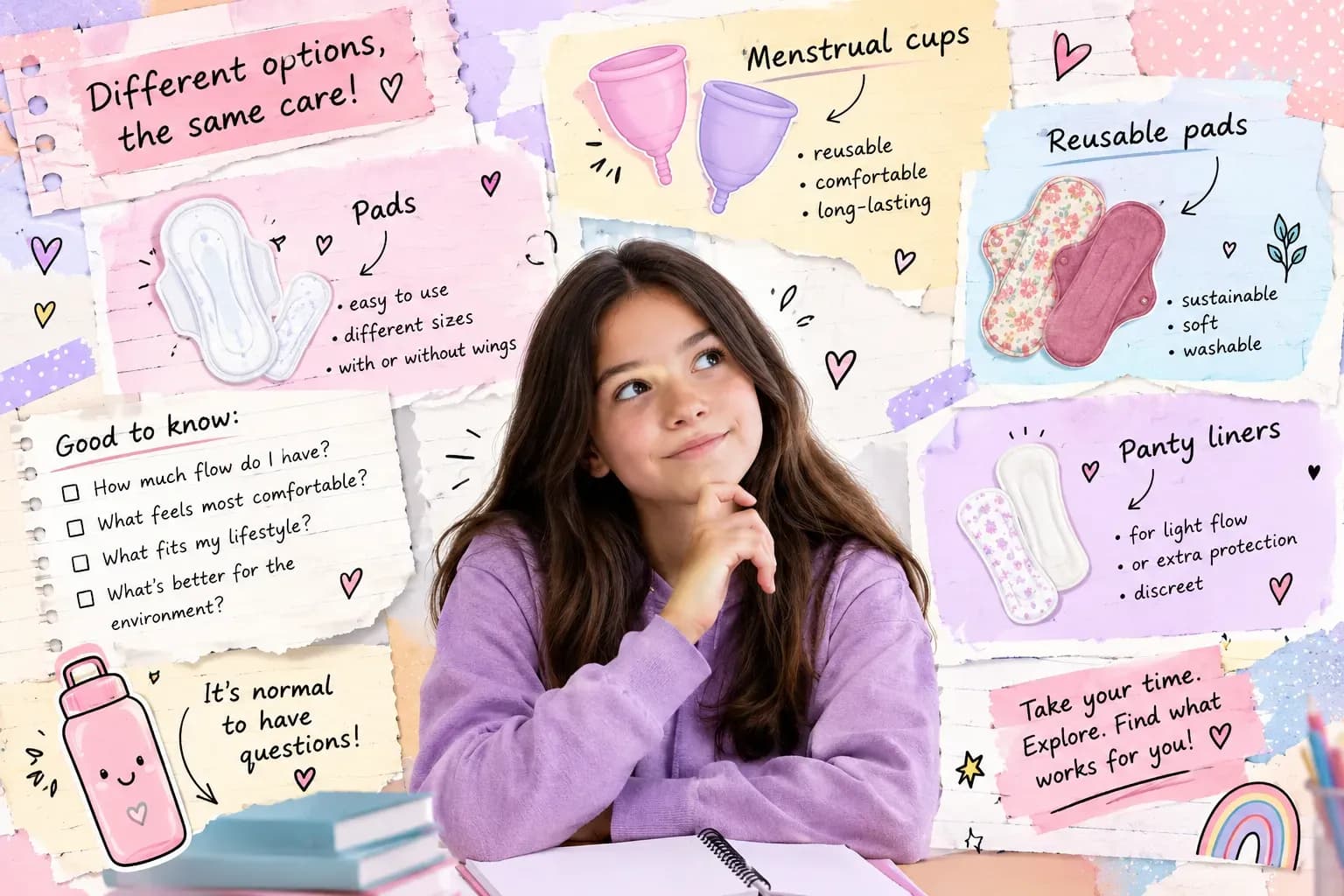
Can you use tampons for your first period? Myths and facts
Tampons can be an option from your very first period. Learn how they work, whether they can hurt, and what you need to know to use them safely.
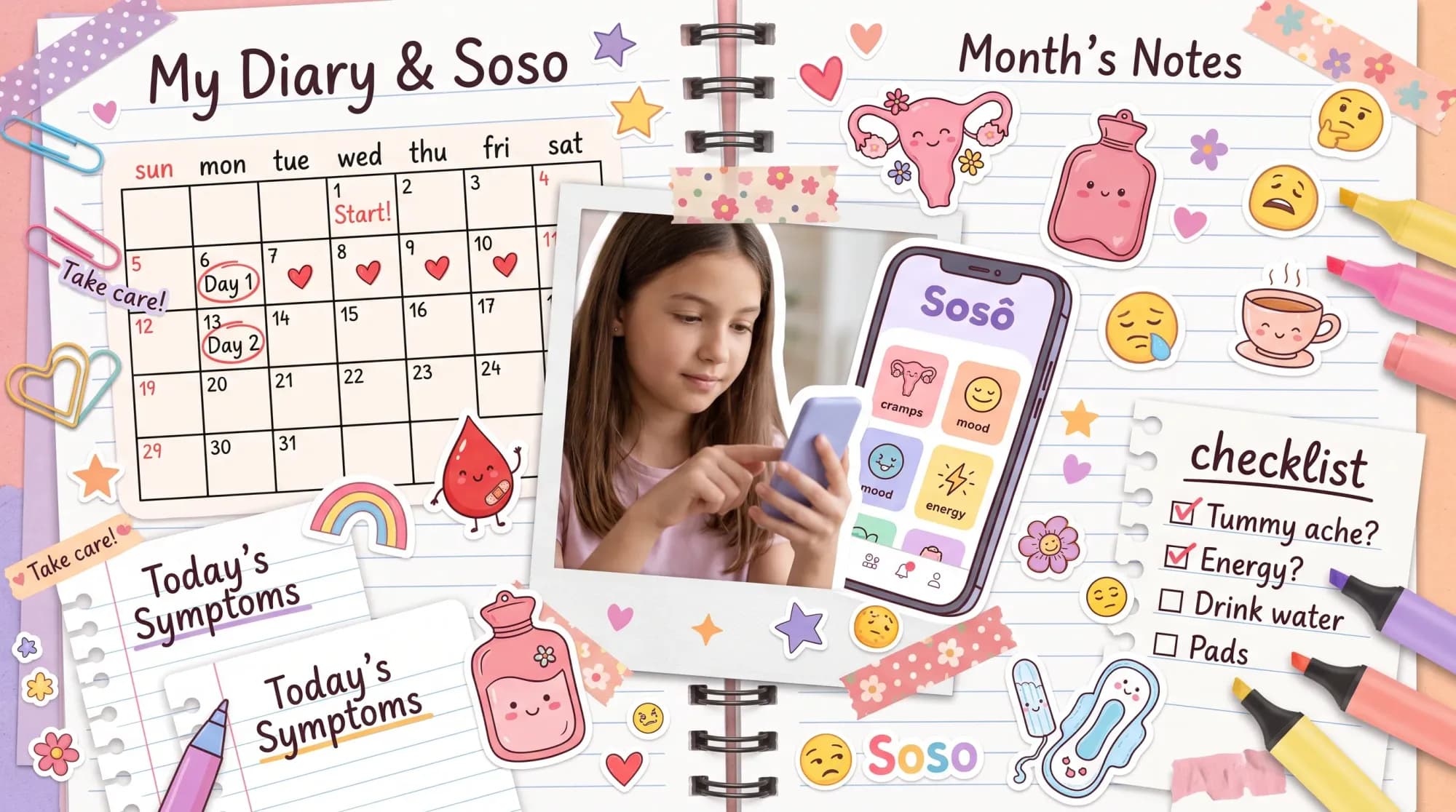
Period symptoms: what they are and how to track them
Cramps, bloating, tiredness, headaches, and other changes can happen before or during your period. Learn what you might feel and how to track everything in Soso.
Soso Answers: Breast Growth, Body Comments and Brain Changes (September 30 to October 7)
This week you asked whether breasts can grow faster, what to say when a friend says her body is better than yours, whether you can get ready for PMS, what to do when your mum keeps saying no to a period kit, and whether your brain changes at puberty. Here are the real answers.