Understanding Your Menstrual Cycle
Your cycle is so much more than your period. Here's a friendly walk through the four phases your body moves through every month, and why tracking it helps.
Your period is just one part of a bigger, pretty amazing monthly rhythm called your menstrual cycle. Once you understand the four phases your body moves through, the whole thing feels a lot less mysterious. Let's walk through it together.
The basics
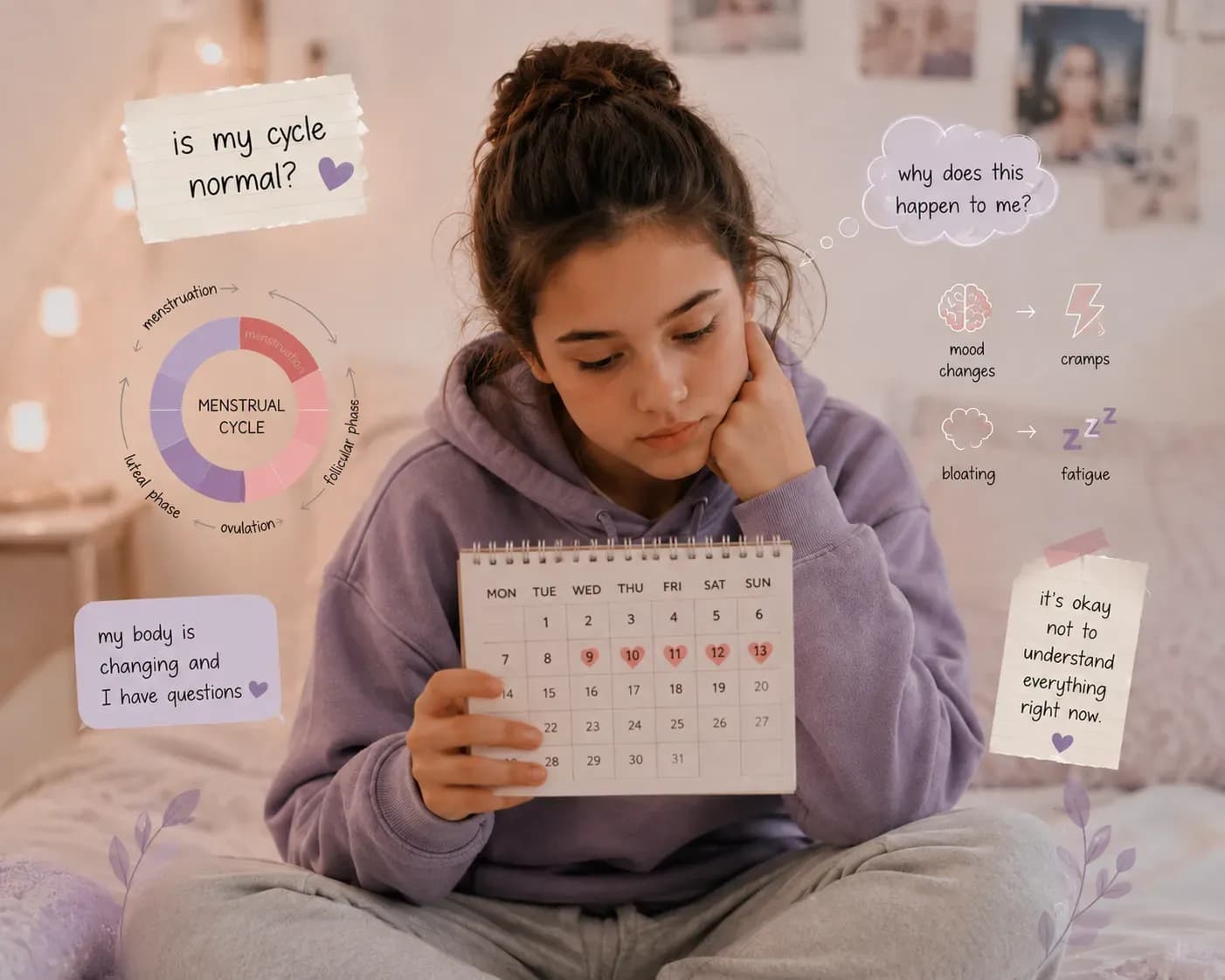
You have probably heard the number 28, and that is a real average for a lot of adults, but it is not the number to measure yourself against yet. In the first couple of years after your first period, cycles run roughly 20 to 45 days, and the average sits closer to 32. You count from the first day of one period to the first day of the next. Inside that window, your body moves through four phases.
The four phases
1. Your period (around days 1 to 5)
This is the part you can see. Your body gently sheds the lining of your uterus, which leaves your body as blood through your vagina.
- Bleeding usually lasts 3 to 7 days.
- You might feel tired or have some cramps.
- Your flow can be light or heavier, and everyone is different.
2. The follicular phase (around days 1 to 13)
Even while you have your period, your body is quietly getting an egg ready.
- Your energy often starts to climb.
- Your mood may lift.
- Your skin often looks clearer.
3. Ovulation (around day 14)
An egg is released from one of your ovaries.
- You might notice clear, stretchy discharge.
- Some girls feel a little twinge on one side.
- This is often when you feel most energetic.
4. The luteal phase (around days 15 to 28)
Your body prepares in case the egg is fertilized. When it isn't, your hormone levels drop and the cycle starts again.
- PMS feelings may show up.
- You might feel more tired or moody.
- Craving certain foods is totally normal.
Why tracking helps
Keeping track of your cycle is like getting to know yourself better. It helps you:
- Know roughly when your next period is coming.
- Understand your own patterns and moods.
- Notice if something seems off, so you can mention it to a trusted adult.
When your cycle is irregular
In the first few years, irregular cycles are super common, your body is still finding its rhythm. Things like stress, sleep, and what you eat can all nudge your cycle around too. That's all part of growing up.
Remember
Your cycle is your body working exactly as it should, month after month. The more you get to know it, the more at home you'll feel in your own skin, and Sosô is right here learning it with you. 💛
Comments (0)

Veronica Tarsitano is a nursing student and a Brazilian living in Portugal. Married and a mother of three, including the girl who inspired the name "Sosô". She writes based on the real-life experience of closely following a daughter's first period, without filters.
Download the Soso app and put this into practice
Download the appRelated Posts
How to tell the difference between spotting and a period
Spotting is light and irregular bleeding, while menstruation usually lasts longer and follows the cycle’s usual pattern.

Period cramps or stomachache? How to tell the difference and help during early adolescence
Your daughter has a stomachache and you are not sure whether it is menstrual cramps? Learn how to recognize the signs and help your daughter understand her body without fear or drama.
%25201200x675%2520pixels%2520(2)-1.webp&w=3840&q=75)
I woke up to a stained sheet: what to do in the middle of the night without panicking
Waking up and noticing a blood stain on your sheet can be scary, especially when it happens for the first time. But the truth is that this kind of situation is much more common than you might think.